Category Archives: News

The Holy Father’s February 2018 Intentions

Say “No” to Corruption

That those who have material, political or spiritual power may resist any lure of corruption.

From an excerpt by Rev.  William Blazek, SJ,  the director of The Pope’s Worldwide Prayer Network:

[T]he founder of the Jesuits (Saint Ignatius of Loyola) knew that riches, power and pride were all closely interrelated. The enemy of our human nature leads us to think our gifts and abilities are our own or that having some power might bring us material, social or spiritual wealth.

…

“[P]ut away the old self of your former way of life, corrupted through deceitful desires, and be renewed in the spirit of your mind and put on the new self, created in God’s way in righteousness and holiness of truth.” (Eph 4:22-24)

The Holy Father’s January 2018 Intentions

That Christians in Asian countries may be able to practice their faith in full freedom.

Please read the inspiring homily by Pope Francis at the 2015 Mass of Canonization of Saint Joseph Vaz († 1771).  He was an Oratorian missionary priest who was born in India and ministered in Sri Lanka, a country that, despite the best efforts of this holy man, was and remains today to be predominantly Buddhist.   His feast day is January 16.

https://w2.vatican.va/content/francesco/en/homilies/2015/documents/papa-francesco_20150114_srilanka-filippine-omelia-canonizzazione.html

Holy Father’s December Prayer Intentions

The Elderly


That the elderly, sustained by families and Christian communities, may apply their wisdom and experience to spreading the faith and forming the new generations.

For more information, visit the Apostleship of Prayer.

Holy Father’s November Prayer Intentions

Christians in Asia

That Christians in Asia, bearing witness to the Gospel in word and deed, may promote dialogue, peace, and mutual understanding, especially with those of other religions.

For more information, visit the Apostleship of Prayer.


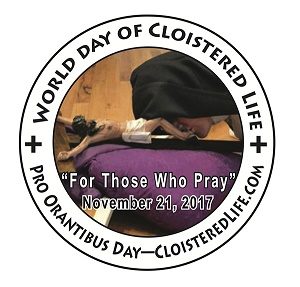
Tuesday, November 21, 2017 – World Day of Cloistered Life

On November 21 (the Presentation of the Blessed Virgin Mary in the Temple), the Church will celebrate World Day of Cloistered Life, also known as “Pro Orantibus” Day, which is a Latin phrase meaning “for those who pray.” This is an important ecclesial event for all Catholics worldwide to commemorate the hidden lives of consecrated religious in cloisters and monasteries.

We celebrate this day because the contemplative life is a gift from Almighty God to us all — all the world benefits spiritually from the prayer and sacrifice of these dedicated and faithful souls, even when we may not know it. On this day, the faithful are encouraged to reach out to the cloistered and contemplative communities in their diocese, through prayer, encouragement, and material support.

Please click at the link for more info and for resources: //www.cloisteredlife.com/news/pro-orantibus-day/

Holy Father’s October Prayer Intention

Workers and the Unemployed

That all workers may receive respect and protection of their rights, and that the unemployed may receive the opportunity to contribute to the common good.

For more information, visit the Apostleship of Prayer.

“The one who has Hope lives differently” says Pope Benedict XVI

Saint Paul in his epistle to the Hebrews writes that the Christian virtue of “Hope” is set before us as “an anchor of the soul, sure and firm.” (cf. Heb 6:19) The anchor of a ship is that substantial piece of equipment that when thrown down, grabs hold of the solid sea bed below.  The winds may blow and the waves crash about, but the anchor provides security and stability until the skies clear and the waves calm.

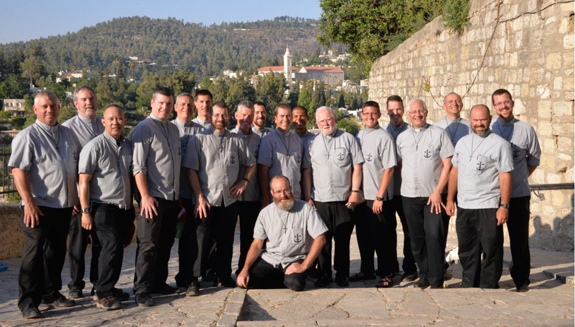
The community of religious brothers called the Brotherhood of Hope was founded in 1980 by Father Philip Merdinger.  With their motto as “Primum Deus, Deus Solum”, Latin for “God First, God alone”, this community  based in Boston, MA wears on their habit the Anchor.

With 18 young men in Brotherhood formation as of this writing, these serious, yet joyful men prepare to labor in the harvest of the Lord with a zeal for the “lost sheep”, particularly college students and young adults who are especially vulnerable to being lost in the storms of the increasingly secularized and hostile culture with its many allurements and distractions.

From the earliest days of the Church, the Anchor has served as a powerful symbol of Hope in Christ our Resurrected Savior and His promise of eternal salvation, with countless examples found on the epitaphs of the faithful departed within the catacombs in Rome.

The important work of the Brothers is that in their apostolate, in their fidelity to Christ and to the Church and their works of mercy, they inspire Hope and demonstrate the “freedom of the glory of the children of God” (Rom 8:21)

//brotherhoodofhope.org/

Holy Father’s September Prayer Intention

Parishes

That our parishes, animated by a missionary spirit, may be places where faith is communicated and charity is seen.

For more information, visit the Apostleship of Prayer.

Consecration to Our Lady of Czestochowa

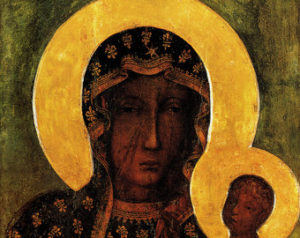
This weekend the Church celebrated the Feast of Our Lady of Czestochowa. This feast commemorates the famous icon of Our Lady that, according to legend, was painted by St. Luke at the house of the Holy Family. The icon ended up in Constantinople due to the efforts of St. Helena, and then was brought to Poland before the fall of Constantinople in the 15th century. The icon became the spiritual heart of the Poles, reminding them of Mary’s maternal care through the hardships of their history. In 1979, shortly after becoming Pope, Saint John Paul II traveled to Poland in what has been remembered as the “Nine Days That Changed the World.” On that trip, he went to Jasna Gora, the home of Our Lady of Czestochowa, and reminded the Poles to consecrate “everything through Mary.” He urged them to give over to Mary’s maternal heart all their sufferings, sacrifices, and hopes. Only in Her, who is rooted in the Son, will they find the liberation they were seeking, the freedom grounded in authentic self-gift that only Christ can give.

Poland is a country that not only sees its history through the lens of Providence but a land where it is very common to find people who see their own particular histories through the dynamics of the Faith. Dedication to Mary is part of that. It begins in the home, especially through daily recitation of the Rosary and simple acts of consecration to Mary at a young age. Religious vocations flourish in such a culture because life is interpreted as bring from and for God, encouraging the youth to make Mary’s “fiat” an integral part of their lives. The vow of consecration and the vow of marriage are seen as participations in Mary’s way of life who is both Virgin and Spouse. The Institute on Religious Life has a special devotion to Mary since she is the Mother of Vocations. Each day we should pray through Mary for vocations, and we should look to Our Lady of Czestochowa for help and guidance.

St. Bernard of Clairvaux – Promoter of the Religious Life Par Excellence

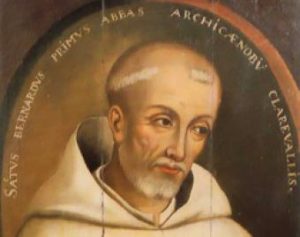
St. Bernard of Clairvaux inspired many vocations to the newly founded Cistercian Order. Famously, he managed to bring his uncle, his brothers, and a group of young nobleman to the same vocation. He even convinced his sister to leave her husband and become a nun. His charisma transformed Europe in the 12th Century. Benedictine Jean Leclercq, O.S.B. (1911-1993), known for his magisterial The Love of Learning and the Desire for God, wrote this informative paragraph as part of an introduction to Bernard of Clairvaux: Selected Works (this paragraph shows you how much a contemplative can do):

“In 1115, just three years following his arrival at Citeaux, Bernard was sent to found a monastery at Clairvaux in Champagne, to which he led his brothers and companions, and attracted many other young men as well. Soon he was in a position to make other foundations, in 1118, 1119, 1121, and almost every year after that. He made 68 foundations in thirty-five years and was the principal promoter of his Order, which, at the time of his death, comprised some 350 houses, of which 164 were answerable more or less directly to his authority. They extended across the whole of Europe, from Scandinavia to southern Portugal, from northern England to central Europe. A spiritual motivation had to be ensured in each monastery, beginning with the motherhouse. It has been estimated that between 800 and 900 monks had been part of the community of Clairvaux before Bernard’s death. Some of them were sent to daughterhouses that, in turn, made other foundations. Thus, there were thousands of men, generally young, who left society and often a military career to take up cloistered life. If to this number one adds the members of some 290 other Cistercian monasteries founded during Bernard’s lifetime, one has some idea of the tremendous peace corps, with tens of thousands of members, that Bernard helped to establish. What architect of peace has played such a role in his century or in any other?”