Mother Foundress of the Alexandria Carmel Passes Away

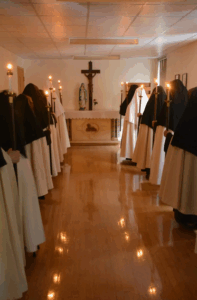
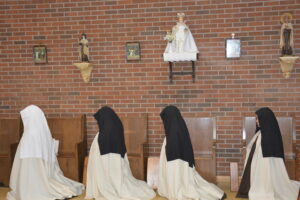
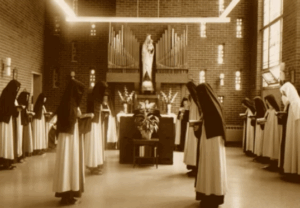
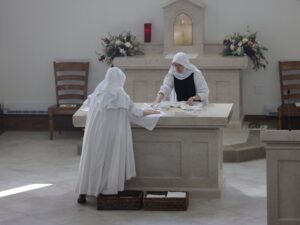
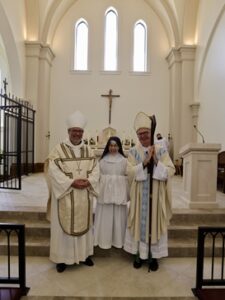
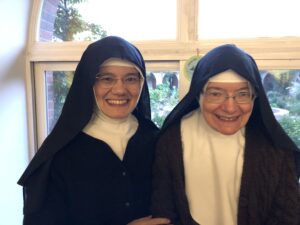
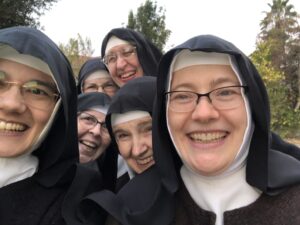
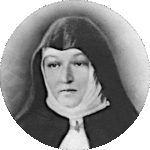
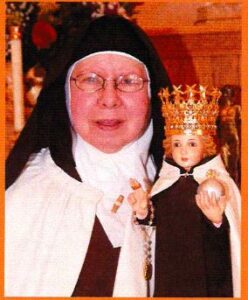
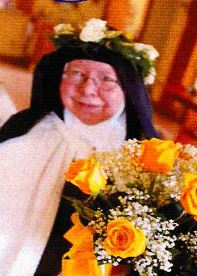
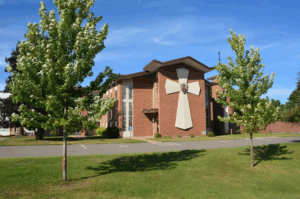
On October 9, 2025, Mother Marie Therese of the Child Jesus, OCD, died at her monastery in Alexandria, South Dakota.  Born Theodora Elizabeth Cycyk in Tonawanda, NY, in 1946, to Ukranian immigrants, she was fascinated by nuns but never saw herself as one of them.  That is, until the day when she randomly opened The Guide to Catholic Sisterhoods in the United States, and happened upon the Discalced Carmelite communities, featuring a picture of St. Therese of the Child Jesus and the Holy Face. So taken was she by this picture that she was happy to discover that there was a Carmelite monastery in nearby Buffalo! She entered Carmel on November 9, 1965.  This year she just missed celebrating her 60th Jubilee.

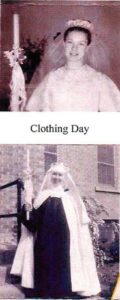
Mother Veronica had a name picked out for her on her clothing day but when she saw Theodora dressed up in her wedding dress, her hair in a bun atop her head looking like St. Therese, she changed her mind and gave her the name, Sr. Marie Therese of the Child Jesus.

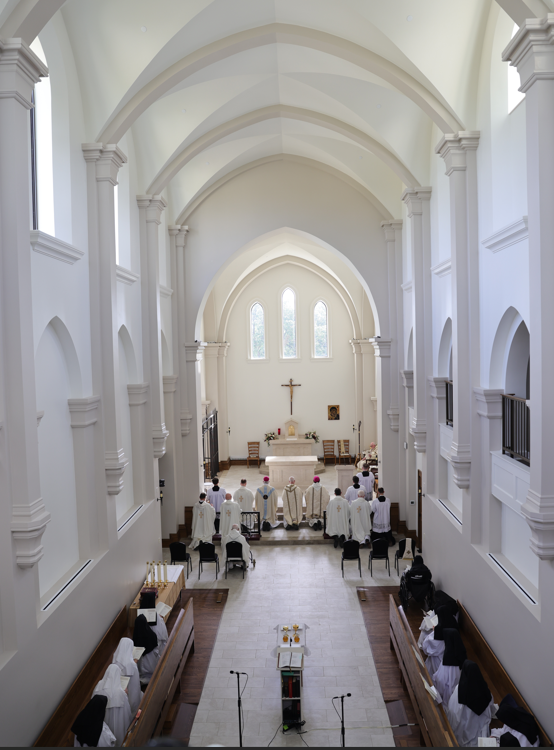
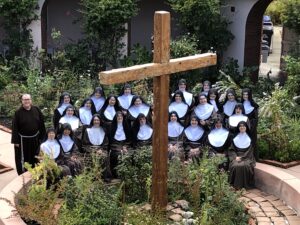
Mother Marie Therese became Novice Mistress and then Prioress.  In 1996, she agreed to a request by Bishop Robert Carlson to make a new foundation in the Diocese of Sioux Falls, South Dakota.  They revamped a property offered by Fr. Robert Fox (the Fatima Priest) located across from the Fatima Family Shrine, the first monastery of contemplative nuns in South Dakota. “Here I will leave her bones!” she said.

On the day of her death, the sisters were alerted to her condition and finished their daily rosary at her bedside.  A priest administered the Apostolic Pardon just before she died. Her funeral took place on October 13th, the anniversary of the Miracle of the Sun at Fatima.

From her sisters:  Please join us now as we earnestly pray that if Mother Marie Therese is not there already, Our Lord will soon welcome her into His loving embrace in an “Eternal Face to Face” (St. Therese). Know that we (and she) are most grateful for your prayers, and that Mother will be most anxious to recommend you, your loved ones, and your concerns to Jesus.

Monastery of Our Mother of Mercy & St. Joseph
PO Box 67
Alexandria, SD 57311

You can go to their website to support their building campaign to build a new chapel dedicated to the Holy Face of Jesus!

HolyFaceChapel.org

First Diocesan Hermit for the Diocese of Des Moines

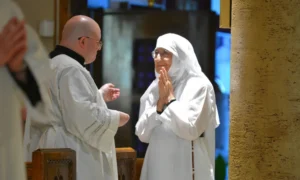
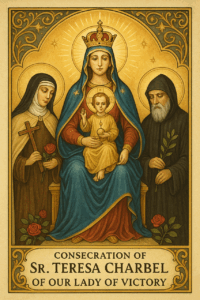
For two years, Victoria Carver attended the IRL’s National Meeting as a lay woman.  As of October 16, 2025, the Feast of St. Margaret Mary Alacoque, she is officially the first Diocesan Hermit in the Diocese of Des Moines in Iowa.  Now known as Sr. Teresa Charbel, Er.D., she was consecrated at the Basilica of St. John by her bishop, Most Rev. William Joensen.

The following are excerpts of her story as written on the Diocese of Des Moines website:

She’s taken a circuitous path to consecrated life. At age 79, she’s a mother of four, grandma to 11 and great-grandma to five. She was divorced in 1980, and her marriage was annulled by the Church in 1984. She’s a recovering alcoholic who converted to Catholicism in 2000.

“Recovery is rooted in regular prayer and other daily practices that build virtue and foster humility,” she said. “As I surrendered to God in desperation and continued in faith, His power enabled me to do what I could not, and I began to experience miracles in my life.”

Intense and committed intercessory prayer, when one of her children faced a health crisis, led her deeper into prayer, as she called on St. Teresa of Avila and St. Teresa of Kolkata (also known as Mother Teresa) for heavenly help.

“People began asking me to pray for their intentions, and my heart got bigger, growing in charity, as I prayed for others,” she said. Involvement in a lay religious movement led her to a spiritual director, daily adoration, and praying the Liturgy of the Hours. She committed her life to the Lord on retreat and thought she was called to found a women’s religious order in the Diocese of Des Moines.

 “Many desire to see women’s religious life flourish here again, as it once did. Our diocesan priests and parishes need it. Families and young women need it,” she said.

“Though Bishop (Richard) Pates agreed and, in 2015, supported the concept I proposed, my efforts bore little fruit. …I’ve had to learn the hard way that God doesn’t lead me by giving me the end point. If he did, I would plan my route to get there,” she said, “and I’m not a very good planner. Instead, he just leads me to the next stop. I needed to learn to follow him and his shepherds with docility and trust.”

She met regularly with priests and her spiritual director who advised her on canon law, church history, and others who could help her to discern.  Eventually her spiritual director recommended that she inquire with her bishop about becoming a diocesan hermit.

“The next year, I met with newly installed Bishop Joensen, who was open to exploring my request for eremitic consecration, helping close the door on founding a new order.”

For the next few years, Sister Teresa received rigorous formation through much solitary prayer in adoration and study.

When it came time to write a Plan of Life to present to Bishop Joensen — which she didn’t know how to do — two diocesan hermits from a Nazareth Hermitage, in Ava, Missouri, sought overnight accommodations in Des Moines. …. These were the first hermits she had ever met in person.

“Sister Maria Dara affirmed my eremitic vocation, taught me to write a Plan of Life, and I presented it to Father (PJ) McManus. Bishop Joensen read it, consulted Father and other priests, and asked me to live with some experienced hermits in formation for at least four months. One hermitage was vacant at the Nazareth Hermitage compound and I was enthusiastically welcomed there.. . . which ultimately led to my consecration this month.”

During her consecration, Sister Teresa made vows of poverty, chastity, and obedience to the Bishop. After her name will be the letters ER.D., for “erimetic,” a descriptor of a hermit and “diocesan.” She wears a white habit that stretches from her hair down to her feet.

Pope Leo XIV said that “to be a hermit, he said, “is not an escape from the world, but a regeneration of the heart, so that it may be capable of listening, a source of the creative and fruitful action of the charity that God inspires in us.”

To read the full article, visit the Diocese of Des Moines website.

From the Code of Canon Law, here is a description of the life of a hermit or anchorite:

Canon 603. §1 Besides institutes of consecrated life, the Church recognizes the life of hermits or anchorites, in which Christ’s faithful withdraw further from the world and devote their lives to the praise of God and the salvation of the world through the silence of solitude and through constant prayer and penance.

§2 Hermits are recognized by law as dedicated to God in consecrated life if, in the hands of the diocesan Bishop, they publicly profess, by a vow or some other sacred bond, the three evangelical counsels, and then lead their particular form of life under the guidance of the diocesan Bishop .


Joy Within His House: A Cloistered Nun’s Reflections on Following Christ

Sr. Mary Magdalene of the Immaculate Conception, OP, a member of the  Dominican Monastery of Our Lady of the Rosary in Summit, New Jersey,  has written a book to give those who live on the outside of the cloister a glimpse into the experience of those who live within. Called Joy Within His House: A Cloistered Nun’s Reflections on Following Christ, in it she shares the joy she finds in living the life of a cloistered nun and following Christ. Several dozen captivating photographs from inside the cloister help to illustrate the prayer, study, work, and recreation that order the nuns’ days.

Sr. Mary Magdalene of the Immaculate Conception, OP

Many people may have misconceptions about monastic life, especially the cloister: what nuns do all day, what they are like, why they choose this life, and what they have given up. A life of contemplation is not something esoteric, secretive, or hidden; rather, it is a mystery.

Despite facing some different day-to-day realities, you might just find one or more facets of that mystery that will enrich your own life. This book demonstrates that laypeople can also take the principles of Dominican spirituality and monastic life and use them as tools to help them grow in holiness. to encourage others to become saints, and to try to give lay people the principles of monastic life that they can use to help them live as better Christians.  At the same time, religious can glean many helpful points from it as well.

At the Dominican Monastery in Summit, the Holy Sacrifice of the Mass is the heart of their monastic life, where they unite their lives with Christ which is then offered to the Father in a holocaust of praise for the salvation of the world. The Divine Office flows out from the Holy Sacrifice of the Mass, extending their worship of God throughout the day. Flowing from their life of liturgical praise is private prayer and lectio divina. They also have the special privilege of both perpetual adoration of the Blessed Sacrament joined with the prayer of the rosary. This they call the Adoring Rosary.

For those who would like to visit their monastery chapel, here is something amazing they can see — a 400 years old copy of the Shroud of Turin!  This Shroud replica was commissioned by the Most Serene Infanta, Maria Maddalena of Austria, Grand Duchess of Tuscany, wife of Cosimo de’ Medici in April, 1624. To give the copy greater value it was placed for a time on the Shroud of Turin. In gratitude for the generous help of the fledgling Monastery in Summit, New Jersey after World War I, the Dominican Nuns of St. Catherine’s Monastery gave it to the Summit Dominican Nuns on April 6, 1924.

To order:  please visit the Dominican nuns’ Cloister Shoppe or Amazon or the OSV Catholic Bookstore.  The Cloister Shoppe also has their famous Seignadou Soap products and other handcrafted goods like greeting cards, candles, and handmade wood rosaries.

The book will be released on October 13, 2025, but you can pre-order to reserve a copy!

To learn more about the community: summitdominicans.org

“Charitably and Cheerfully Challenging the Cheap Chapel Change” by Trent Beattie

Cathedral of St. John the Evangelist, Lafayette, LA – Conrad Schmitt

After encountering some severely simple convent and monastery chapels, I asked friends in the architecture world to suggest material that would contradict the cheap chapel change mindset. Two of the books suggested were Stones Laid Before the Lord: Architecture and Monastic Life, by Anselme Dimier, and Religious Poverty, Visual Riches by Joanna Cannon.

One of the architect-friends, however, summed it up in two paragraphs. I had been expecting a book with quotes from artistic and saintly souls (such as Catherine of Bologna, a Poor Clare, as well as Fra Angelico and Venerable Samuel Mazzuchelli, both Dominicans) who, despite their own freely-chosen personal poverty, enthusiastically emphasized the eternal value of sacred art. What I got was this eagle-eyed observation that may help to qualify my friend for the artist-saint category:

Cathedral of Christ the king – Atlanta, GA – Daprato Rigali

The history of the architecture of religious orders until the emergence of modernism is replete with counter-examples to this [cheap chapel] attitude, whether for mendicant orders or otherwise. What examples we have of stark religious architecture are often the result of being unfinished or a prior finish later destroyed.

Even where noble simplicity was the stated aim of a religious community, the minimalism extolled today as its purported heir stands as much in contrast to that humble aesthetic as the machine does to nature. Even “Cistercian simplicity” before modernism ranges from the dressed and hand-carved stone of the Romanesque to the ecstatic flights of the Rococo in ways that render the term “simple” anachronistic when used today to refer to those earlier eras as somehow identical or even analogous to the “simplicity” now championed.

Some communities appear to be laboring under the assumption that, not only personal property, but even sacred art is an impediment to union with God. This might seem like a supremely noble pursuit of perfection, but it is actually an anti-Incarnational misconception. Even one of the top mystics of the Church fell prey to it before being set free.

 How Great Thy Art

In The Passion and Death of Jesus Christ, Saint Alphonsus Liguori recounts a story about Saint Teresa of Avila, saying that she “complained of certain books which had taught her to leave off meditating on the Passion of Jesus Christ, because this might be an impediment to the contemplation of his divinity.” He continued, writing that Saint Teresa exclaimed:

O Lord of my soul! O my Jesus crucified, my treasure! I never remember this [iconoclastic] opinion without thinking that I have been guilty of great treachery. And is it possible that You, my Lord, could be an obstacle to me in the way of a greater good? Whence, then, do all good things come to me, but from You?

San Joselito Chapel – Before & After – Norwalk, CT – Canning Liturgical Arts

How can this be remembered and lived out when Crucifixes or the Stations of the Cross are so small, colorless, or vague that they are nearly or totally unidentifiable? The purpose of sacred art is not to satisfy a bare-minimum church checklist, but to help us enter into the reality of the Incarnation via the Sacred Humanity of the Lord.

 Beauty Embarkment

There are many resources explaining why chapels should be beautiful—including the Bible (such as Jacob’s exclamation about the majesty of the temple Genesis 28), Saint John Damascene (a monk who strongly defended the value of sacred art), the Second Council of Nicaea (which repudiated the heresy of iconoclasm), and the Catechism of the Catholic (which stated in the explanation of the Commandment about not bearing false witness, that genuine sacred art draws us to the adoration and love of God).

These resources, along with images showing how magnificently chapels can glorify the Lord and sanctify worshipers, should be enough to ignite the spirit of the Transfiguration within religious communities. A charitable and cheerful challenge is hereby extended to our cheap chapel chums to add identifiable and colorful stations, statues, mosaics, paintings, and other decor as part of their sacred art.

St. Paul Center- University of Wisconsin – Ever Greene

Because real artists are needed for this beautification, it is worth mentioning that Daprato Rigali Studios (whose work can be seen in the image of the Ann Arbor chapel of the Dominican Sisters of Mary, Mother of the Eucharist), Conrad Schmitt Studios, Ever Greene Architectural Arts, and John Canning Company are four of the best-known groups that can help chapels change back to the glorious ways of the Church.

St. Catherine of Bologna, Bl. Fra Angelico, Ven. Samuel Mazzuchelli, OP,  and all artistic-saintly souls, pray for us to better understand how to employ material means to attain greater union with the goodness, truth and beauty found in the Almighty God who became a man in the Incarnation, whose beginning is celebrated on the Annunciation (March 25).

Trent Beattie has written or edited books on topics such as sports and spirituality, scrupulosity, and St. Alphonsus Liguori. He has written numerous articles for publications such as the National Catholic Register, Catholic Digest, The Latin Mass, Columbia, Sacred Music, and Religious Life.

NEW BOOK! Espoused to Christ: A Theology of Consecrated Virginity

Although consecrated virginity lived in the world is the oldest form of consecrated life in the Church, it is also one of its most hidden treasures. However, since the Second Vatican Council called for the renewal of this vocation, increasing numbers of women have sought to discover whether the Lord is calling them to become His mystical bride, and the number of consecrated virgins continues to increase worldwide.

Specifically addressing consecrated virginity lived in the world, this book by Erin Kinsella, CV, is an invaluable and timeless resource for women discerning and in formation, as well as bishops, formators, and even the already consecrated. It covers topics including:  The nature of vocation and unique aspects of various vocations in the Church; the charisms of celibacy and virginity in the history of the Church and now; the Holy See’s instruction on consecrated virginity in Ecclesiae Sponsae Imago; the prophetic role in the Church of the vocation of consecrated virginity lived in the world; the Marian nature of this vocation and the call to live in imitation of Our Lady; the essence of brideship and spousal love, and the gift of spiritual maternity.

Espoused to Christ provides both a theological framework for understanding this vocation and real-life applications that illustrate how to live it, with helpful Scripture passages and reflection

You can order it here: SophiaInstitute.com

Erin Kinsella was consecrated to a life of virginity lived in the world on September 14th, 2019. One of the challenges that she faced…and that many women face…is finding helpful resources for discernment and formation that are specific to consecrated virginity. Her website (espousedtochrist.com) is meant to be a tool that can point people toward useful resources for discerning consecrated virginity.


Emotional Holiness: Discovering the Divine Plan for Your Human Emotions by Abbot Austin Murphy, OSB

IRL Board Member, Abbot Austin Murphy, OSB, has written the very timely and timeless book entitled Emotional Holiness: Discovering the Divine Plan for Your Human Emotions, available from Our Sunday Visitor. To become a better Christian, you need to form your emotions aright. The traditional Catholic view—supported by giants in the Catholic tradition such as Saint Augustine, St. Bernard of Clairvaux, and St. Thomas Aquinas—is that ongoing conversion does not mean suppressing, ignoring, or eradicating the emotions, but reforming them.

In Emotional Holiness, Abbot Austin Murphy, OSB, shows how the emotions are to be shaped and trained so that they work with your pursuit of all that is good and avoidance of what is evil. Getting the emotions to work with the mind’s pursuit of God and the things of God is especially important to help you persevere in your God-given vocation.  (OrderOSV.com)

Abbot Austin Murphy was the Abbot of St. Procopius Abbey in Lisle, Illinois, from 2010 to 2024.  He earned a PhD in theology at the University of Notre Dame, focusing on the thought of St. Augustine.

Discalced Carmelite Nuns of Jacksonville to Relocate to Connecticut

From the nuns’ website:  www.carmeljax.org

J. M. † J. T.

MONASTERY OF THE LITTLE FLOWER OF JESUS
Discalced Carmelite Nuns of Jacksonville
8002 James Island Trl
Jacksonville, FL 32256

July 26, 2025

Pax Christi! To all our dear friends in Christ, Praised be Jesus Christ! Many of you have been asking for an update regarding our search for a permanent location, and after months of prayer and discernment, we are now able to share some exciting news.

As we were about to begin fundraising to purchase property and commence building a new monastery in northeast Florida, we were made aware of several Church properties in other dioceses that were available and being offered to us, which would promptly enable us to resume our strictly cloistered life. Our living quarters for the past eighteen months have proven inadequate for daily monastic observance, and unfortunately there are no vacant Church properties available in this area. Moving to a larger and more suitable home had become imperative for a variety of reasons, so we took the matter to fervent prayer. The thought of being able to live our structured contemplative life again sooner rather than later was very appealing, and moving to a larger house would enable us to welcome new vocations.

Therefore, with the sympathetic blessing of our dear Bishop, the Most Rev. Erik Pohlmeier, we investigated these possibilities, and several Bishops who were very eager to have a cloistered Community in their diocese extended warm invitations. After prayerful discernment, we decided to accept Bishop Frank Caggiano’s generous offer and petition the Holy See for permission to relocate to the Diocese of Bridgeport, Connecticut; that request has now been granted. We will reside at a diocesan retreat center in Danbury, Connecticut while a new monastery is built in a lovely rural area about half an hour away. May Our Lord and His sweet Mother reward Bishop Caggiano abundantly for his extremely gracious welcome! We are deeply grateful to all the wonderful friends we have made in Florida and will always keep them in our hearts and prayers! And we will now be much closer geographically to our dear friends in Buffalo, who have never ceased to have a fond remembrance in our prayerful intercession. Updates on our move and building project will be forthcoming! Be assured of our prayers, as we humbly ask your prayers for us. May God reward you!

Gratefully yours in Jesus, Mary and Joseph The Carmelite Nuns of the Monastery of the Little Flower of Jesus

Following the announcement of relocation to Connecticut, the Sisters will be officially moving on September 9th, 2025. Their new address for the time being will be:
71 Southern Blvd
Danbury, CT 06810

Mother Mary Maddalena Bentivoglio, O.S.C. & Liturgical Embroidery

by Sr. Mary Rose Mormino, O.S.C.

The Order of St. Clare hopes that Servant of God Mother Mary Maddalena, OSC, who brought Poor Clare life to America, will one day be canonized.  Here is an article on her exquisite embroidery skills that were used to support the community and to glorify God.

Mother Mary Maddalena, the foundress of the Poor Clares in America, came from an old Italian family, the Bentivoglio’s of Bologna.  She was born in 1834 and received the name Annetta at baptism. The ladies of the Italian nobility received a genteel education, suitable for their rank in society. Their training included proper deportment and manners, as well as the cultivation of singing and music, such as playing the piano, organ, or other musical instruments. They were often fluent in foreign languages, such as Latin and French. The young women were also known for their fine sewing, needlework and embroidery.  Reading her biography, we learn that Annetta Bentivoglio was proficient in all of these areas.

After her parents died, Annetta joined the Poor Clares of San Lorenzo-in-Panisperna, taking with her the needlework skills she had learned as a girl. She became quite a needlewoman, doing all types of embroidery, as well as ordinary sewing.  There is preserved one of her tunics in which none of the original material remains. In the end, the whole tunic consisted of nothing but a series of patches, all done so skillfully that not a seam is to be seen. Years later, in her monastery in Evansville, Indiana, it is said that even though her sight was failing, she could still sew just by the feel of the thread.

After being sent to America, Mother Maddalena’s needle helped support the little Community of nuns, when they had no other means of sustenance. She was over-joyed when she could do liturgical sewing, and felt that nothing was too good for our Lord.  Gradually young women joined her, and she taught these young nuns how to make the various linens for the altar and for the use at Holy Mass.

Mother Maddalena died in the Evansville Poor Clare monastery in 1905, but some of the nuns who had joined her in Evansville were still alive when our founding Sisters entered there.  Several of them entered within a few years of Mother Maddalena’s death and her memory was very much alive in Evansville. All of our founding Sisters learned the fine, liturgical embroidery that is part of our legacy from Mother Maddalena.  At Evansville, the Sisters also painted exquisite pictures and designs on satin and linen.  We possess some of these palls painted on satin, although we do not know if they were painted at Evansville or by one of our founding Sisters here in St. Louis.

The Evansville Poor Clares founded this monastery in 1959 at the request of Joseph Cardinal Ritter. In his sermon at the dedication of the monastery on August 12, 1959, he observed:

For me, this occasion has a very personal significance. I have been associated with the Poor Clares since my Ordination day in a very special manner, due to my association with the Bishop of Indianapolis, their Monastery being in Evansville, then in the Indianapolis diocese.   Aside from the Community being a source of inspiration to me and of help and prayer for my work as a priest, I have always been impressed with the fact that the Community was a constant source of joy and satisfaction to the Bishops of the Diocese — all of them.

The founding Sisters were truly heroic as they struggled to establish in St. Louis a house dedicated to God. One of the ways they supported themselves was in all types of churchwork, the making of altar linens and vestments. The first members to join in St. Louis all became adept at liturgical work. These in turn have taught some of the younger Sisters.

Although we do not support ourselves any longer by doing liturgical artwork, we still occasionally make altar linens and palls as gifts for newly ordained priests or priest-friends celebrating a Jubilee.  Our main work is the baking of traditional altar breads, which Mother Maddalena also did in her time, and one that we cherish.  All of these are part of our Bentivoglio heritage.

For more information about the Poor Clares of St. Louis, contact:
Monastery of Saint Clare
200 Marycrest Drive
Saint Louis, MO  63129-4813
(314) 846-2618
www.poorclaresstl.org

There is also an Aleteia article on her life.

New IRL Affiliate Community – New Melleray Abbey

Located southwest of Dubuque in Peosta, Iowa, New Melleray Abbey was founded in 1849 by Cistercian monks of their Order from Mount Melleray Abbey in Ireland. The Cistercians of the Strict Observance (Trappists) treasure the balance Saint Benedict provides in his Rule between communal prayer and private prayer. From pre-dawn to night fall, the brothers, in union with the whole Church, gather seven times each day to sing Psalms together in praise of God. They also gather each day to hear the Word of God and for the breaking of the bread in the celebration of the Mass.

Through their guest house and other forms of monastic hospitality, they offer to their brothers and sisters a place where they may find acceptance, peace, and prayer. With Trappist Caskets they support themselves and supply employment to local men and women by making and selling simple wooden caskets and burial urns of exceptional quality. They also provide free caskets for children’s funerals as a work of mercy. (NewMelleray.org)


Little Missionaries of the Sacred Heart – New IRL Affiliate Community

Welcome to a new  IRL Affiliate Community!

The congregation of the Little Missionaries of the Sacred Heart, based in Livorno, Italy, opened a new foundation in the diocese of Des Moines, Iowa, in 2012. Following the desire of their Foundress, Mother Clotilde Gigli (1872-1928), “to work with humility, so that the mercy of the Heart of Jesus may be known,” they are involved in the fields of education, health care, parish work and missionary evangelization.

There are currently four sisters serving in the community in Iowa who work at the Bishop Drumm Retirement Center as registered nurses and certified nurse assistants. “Their presence is cherished in our Diocese,” says Most Rev. William M. Joensen, Bishop of Des Moines, “and they are well respected as holy and dedicated women giving strong witness to Christ in the grace-filled living out of the evangelical counsels.” (LMSHsisters.com)