The Newest Church Doctor Speaks to Every Vocation
 by Sr. Mary Catherine Blanding, IHM
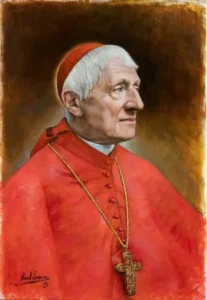
The news thrilled Newman lovers everywhere: on July 31, 2025, Pope Leo XIV confirmed St. John Henry Newman would be a Doctor of the Church. It was a moment of joy for those who have long drawn strength from his writings—and a spark of curiosity for many hearing his name for the first time. What is it about this scholar-saint from Victorian England that speaks to the human heart today?
Why a Doctor of the Church?
Called both “Father of Souls” and “Theologian of Vatican Council II,” St. John Henry offers wisdom that speaks to the contemporary Catholic. He engages both head and heart, championing the laity’s mission to evangelize. In his works, he fosters “real assent” — not just intellectual agreement, but the wholehearted yes of the entire person. Steeped in Scripture and the wisdom of the Church Fathers, his writings proclaim lived Catholic teaching. They awaken prayer, stir the imagination, open hearts, and reach to the very core.
Deeply pastoral, psychologically perceptive, stern yet tender, his sermons speak today with surprising relevance. With his rare blend of intellect and pastoral warmth, he invites his readers into a personal encounter with truth.
By confirming him as a Doctor of the Church, Pope Leo XIV recognized his timelessness. The Church recognizes that his theology and pastoral teaching offer not only intellectual depth but guidance for the Christian people — a light for our moment in history.
To see this clearly, we must first face our own era: many Catholics today drift from the Church. Loneliness grows where hearts go unfed. Most—especially the laity—have never been evangelized or catechized, leaving them without a foundation. In this emptiness, isolation leaves believers vulnerable to secular “solutions,” while religious illiteracy fuels misunderstanding of the Faith.
Even now, men and women—including our fallen-away brothers and sisters—thirst for light, longing for a relationship with the Lord and a clearer knowledge of Catholic teaching. This is where St. John Henry, bearing his Kindly Light, can guide us. I first encountered his poem, Lead, Kindly Light, on a poster I hung in my college room while discerning my vocation, though I did not yet know its author. From that moment, his words accompanied me on the path to religious life.
Lead, Kindly Light
“Lead, kindly Light,” prayed St. John Henry Newman as he sailed back to England after nearly dying in Sicily. At the end of a long journey through Italy, the thirty-two-year-old Anglican priest sensed he had a mission yet to fulfill in England. He led the Oxford Movement—initially intended to renew the Anglican Church—yet, through fidelity to truth, he entered the Catholic Church in 1845. He allowed grace’s Kindly Light to guide him one step at a time, trusting God’s providence in each moment.
Later, the Church recognized his lifelong fidelity and wisdom. In 1879, Pope Leo XIII honored him as a cardinal, and in 2025, Pope Leo XIV proclaimed him a Doctor of the Church (both Popes did so in their first year)—a recognition that continues to amplify his influence today.
Since his canonization in 2019, his influence has only grown. His writings offer those “aha” moments when we think, Yes, that’s exactly how I feel—but I couldn’t have said it myself. His words reach both heart and intellect, and apply to every believer, since each of us is called to the undivided gift of love.
 A Vocation of Love
As a Catholic, St. John Henry held religious life in high esteem. At the solemn profession of a young friend, he began by describing marriage: The very idea of matrimony is possession—the husband is the wife’s and no other’s and the wife is the husband’s and none but his. This is to enter into the marriage bond; this is the force of the marriage vow; this is the lesson of the marriage ring.
(John Henry Newman, as cited by Placid Murray, O.S.B., Newman the Oratorian, 275.)
Marriage… how many today see it like this? How many couples truly think, You are mine in the sacramental sense—not as ownership, but as total self-gift—instead of a contract traded for comfort or benefit?
My own parents embodied this fidelity. My father never looked at another woman; my mother often said, “He treats me like a queen.” They faced real challenges, yet we children never doubted their unity. My mother’s steadfast love taught me the meaning of spousal love—the kind I longed for in my own life.
From Hesitation to Belonging
If you had told me at fifteen that I would become a Sister, I would have laughed. I assumed I would marry. Yet God was quietly planting seeds. During my senior year in high school, I visited the Daughters of St. Paul. When a Sister in a film said, “I am a bride of Christ,” something ignited in my heart—something I pondered, but then put aside.
That reluctance began to fade, especially at Thomas Aquinas College, where I encountered Jesus in the Blessed Sacrament. When I realized He might be calling me, I knew I could not turn to someone else without betraying Him.
 Eventually, Jesus called me from sunny California to Kansas’ golden plains. When I was a novice, our Foundress introduced me to St. John Henry Newman’s writings, and I discovered he had penned Lead, Kindly Light.
At my first vows, I experienced a profound sense of belonging to Jesus—an unshakable union St. John Henry described perfectly in another sermon: And this it is to be married to Jesus. It is to have Him, wholly, henceforth and forever—it is to be united to Him by an indissoluble tie—it is to be His, while He is ours… ineffably united to Him…
(Newman, cited by Placid Murray, Newman the Oratorian, 277.)
Why It Matters Now
Why does this spousal language matter today? Because it speaks to the deepest human longing: to belong completely to another in faithful love. Religious life embodies this visibly, but it is a call addressed to every Christian heart.
In our pragmatic, secular culture, consecration to Jesus is often misunderstood. Sisters are often seen only as teachers or social workers; husbands and wives as partners in a contract. But both vocations—and every Christian calling—are meant to be covenants of love that point to eternity.
In regard to religious life, Canon Law puts it simply: “The apostolate of all religious consists first of all in the witness of their consecrated life, which they are bound to foster by prayer and penance” (CIC, can. 673).
This witness matters because it reminds the world that our ultimate home is not here, but with the Bridegroom who awaits us. The marriage ring—circular, complete, close to the heart—symbolizes belonging. St. John Henry used it to elevate religious life, and in doing so, he also illuminated the dignity of marriage and the call of every Christian to live in covenant love with Christ.
A Final Word
St. John Henry Newman speaks to our time because the remedy for rootlessness, loneliness, and moral confusion has not changed: fidelity to truth and total self-gift to Christ. Blending deep intellect, pastoral tenderness, and the clarity of Scripture, his teaching lights a path to the fullness of Christian life, which is why the Church honors him as a Doctor.
Whether your “ring” is gold or invisible, your vocation is meant to lead you into the heart of the Bridegroom. Let us pray with him:
Lead, Kindly Light, amid the encircling gloom…
Sister Mary Catherine, a Sister of the Sisters of the Immaculate Heart of Mary, authored a book on St. John Henry Newman, published by En Route Publishing. https://enroutebooksandmedia.com/catholicheart/ You can access monthly reflections on the newest Church Doctor’s sermons on the IHM Community Website, “Heart Speaks to Heart.