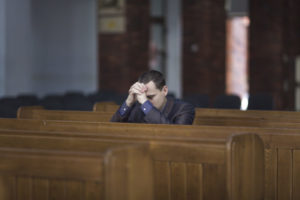
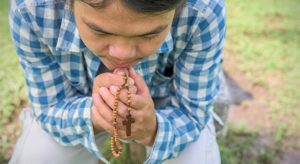
Do I pause to reflect, meditate and ask the Lord to guide me in the major and minor decisions of my day? In what ways has the Holy Spirit helped me to see or hear God’s will in these first months of 2018? Has the bad spirit, the enemy, the tempter, been whispering deceits to me in secret?
…
And this is my prayer: that your love may increase ever more and more in knowledge and every kind of perception, to discern what is of value, so that you may be pure and blameless for the day of Christ, filled with the fruit of righteousness that comes through Jesus Christ… (Phil 1:9-11)
[T]he founder of the Jesuits (Saint Ignatius of Loyola) knew that riches, power and pride were all closely interrelated. The enemy of our human nature leads us to think our gifts and abilities are our own or that having some power might bring us material, social or spiritual wealth.
…
“[P]ut away the old self of your former way of life, corrupted through deceitful desires, and be renewed in the spirit of your mind and put on the new self, created in God’s way in righteousness and holiness of truth.” (Eph 4:22-24)
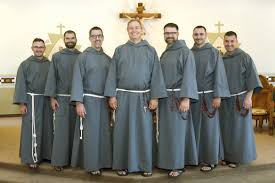
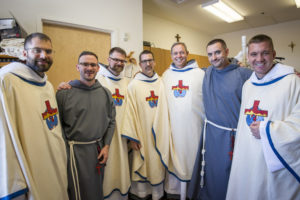
On July 2, 2016, the Franciscan Friars of the Holy Spirit, seven friars in all, were established as a Public Association of the Faithful in the Diocese of Phoenix in a ceremony at St. Francis Mission on the Ak-Chin Indiana Reservation. Their primary mission is to serve the Native Americans in the diocese from their base at the Gila River Indian Community at St John the Baptist Mission. But they also provide campus ministry support at Grand Canyon University and other schools in the diocese as well as evangelization initiatives through prayers groups, missions and conferences.
“This truly is a momentous occasion. Just over a year ago a group of men felt called by God to form a new Franciscan charismatic community in the Diocese of Phoenix,” said Fr. David Sanfilippo, vicar for priests. “After prayerful discernment, the Church officially recognizes and affirms their decision as an authentic call from God.”
The friars were given an abandoned convent on the Gila River reservation where in the old mission a remnant of the faithful were praying that the Franciscan fathers would one day return. “Once we began offering the Holy Mass in the Mission Church that autumn,” they said, “the people came in crowds, smiling and applauding because, ‘the padres have returned!’ We were similarly greeted at the other nine mission churches that are entrusted by Bishop Olmsted to our care.”
The friars felt called by the Spirit to leave their prior community to begin a Franciscan missionary initiative in the desert. The priests and brothers follow the Rule and tradition of the Third Order Regular of Saint Francis of Penance. Not surprisingly, they are growing and attracting new members.
“My dear Friar Brothers — and my sons who have become very dear to my heart in the last 14 months — your religious vows today and your fidelity to them each day hereafter draws you into something revolutionary, something that Jesus uses to transform your lives and society.”
That Christians in Asian countries may be able to practice their faith in full freedom.
Please read the inspiring homily by Pope Francis at the 2015 Mass of Canonization of Saint Joseph Vaz († 1771). He was an Oratorian missionary priest who was born in India and ministered in Sri Lanka, a country that, despite the best efforts of this holy man, was and remains today to be predominantly Buddhist. His feast day is January 16.
That the elderly, sustained by families and Christian communities, may apply their wisdom and experience to spreading the faith and forming the new generations.
“Preach the Gospel as you go for the streets!” ―Poor Friars Motto
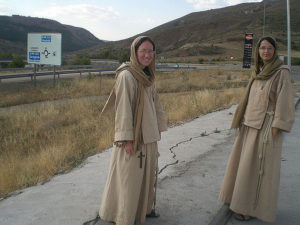
There is a new community in the diocese of Houma/Thibodaux in Louisiana whose members can be seen hitchhiking around the highways and byways of the diocese.
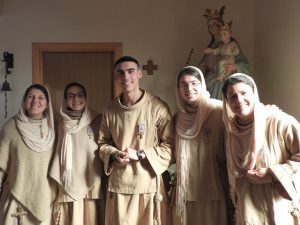
The Little Friars and Little Nuns of Jesus and Mary, also known as the Poor Friars, were founded in Italy and recognized as a Public Association in 2014. They have the Franciscan spirit of poverty and evangelization, and the Carmelite spirit of contemplation and prayer in their cloisters, but have their own unique Rule of Life.
There are many in the world today who do not give serious thought to the Church because of a perceived worldliness in its members and clergy. Where is the poverty of Christ? There are many shining examples among bishops, priests, religious and the laity. But in our day, when people do not notice simple signs of sanctity and heroism, a sometimes more dramatic image must be revealed. This is what the Poor Friars are: a sign of contradiction in our self-absorbed and self-centered culture; the embodiment of true dependence on God for the basic needs in life, as given freely through strangers and neighbors in encounters that change lives forever.
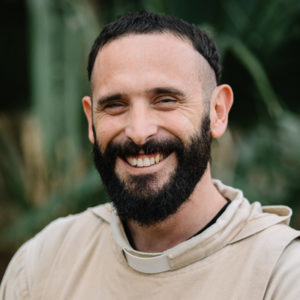
Father Antonio Maria
They personally cannot accept money at all. They also do not own cars so they hitchhike everywhere. “This is where our Apostolate shines,” says Fr. Antonio Maria Speedy, American Provincial, “as while in the vehicle with the people, we invite them to the Sacraments of Confession and Holy Communion.”
Women and men make up the community though they live separately. They minister in four Italian dioceses. In 2010, they were invited by the local ordinary to begin the process of establishing a community in Louisiana. Father Antonio Maria is the chaplain to the Diocesan Office of Evangelization and the Administrator of two parishes.
Here is a description from their website for their reason for being (raison d’être), all the more penetrating because of the charm of the language translated from the Italian!
Today all the world or many, many people in effect have the need to see real poor of the Lord in the Church, because they no longer understand the Benign Mystery of its Glorious Richness; instead of esteeming it they accuse it!, and not only, they also accuse unjustly its Ministers that represent it.. , . instead of becoming nearer they go further ! For this was immediately born the urgency to make ourselves truly poor, so the confused people, in regards to the so called wealth of the Church, no longer having the possibility to point the finger at us, given that they see us extremely poor, they stop, and finally listen to the demonstrated Truth and the simple answer as to why Jesus was poor while now the Church is (rightly ) Rich, and etc.. etc.. ; and like this in fact many, begin to take up again the esteem for their Mother Church and for her Ministers, returning like this to the Holy Confession and to the Holy Communion, and therefore concretely: be on the way towards the Blessed Eternal Life. Amen !
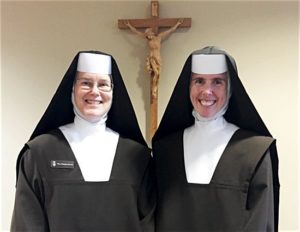
Two Sisters from the Carmelite Sisters of the Most Sacred Heart of Los Angeles came from opposite coasts for a recent Come & See weekend in Saint Paul, Minnesota. Sr. Elizabeth Therese, O.C.D., and Sr. Catherine Marie, O.C.D., live in Alhambra, CA, and Miami, FL, respectively, but have their roots in Minnesota. God’s call is not limited to state boundaries and each sister discerned that God was asking them to leave their home and kinfolk to find their fulfillment as spouses of Christ in the Carmelite community in Alhambra, California. (See article)
Sr. Elizabeth Therese is the vocation directress and slowly realized her vocation from interactions with a campus ministry, a third order Carmelite group, Adoration and monthly discernment dinners. She also was engaged to be married. Though, “it’s not until you have a personal relationship with the Lord, whether you’re called to religious life or marriage,” she said. “that you’re going to be able to know what your vocation is.”
Sr. Catherine Marie felt her call through the Eucharist and Adoration. A teacher, she immediate felt that she had come home once she visited the Carmelites in Alhambra. “It was as if Jesus was saying to me, ‘Welcome home, I have been waiting for you.’”, she said, “Inside my heart I felt myself responding, ‘Finally, I am home.’”
A stumbling block for Sr. Catherine Marie was her educational debt. But thanks to The Labouré Society, located in Eagan, MN, she was able to raise the money to pay off the balance. Sister advises: “Do not be afraid to say, ‘yes’ to Christ,” she said. “He takes nothing away and gives you everything your heart could desire.”
If you live in the California area, please consider becoming part of Handmaidens, a faith formation group for single women between the ages of 18 and 35, dedicated to cultivating a deeper relationship with the Lord, as well as a greater understanding and appreciation of the dignity of their vocation as women. Formation and living holiness in the world is supported and nurtured through adoration, prayer and conferences given by the Carmelite Sisters and chosen laity.
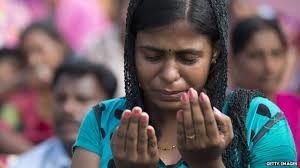
That Christians in Asia, bearing witness to the Gospel in word and deed, may promote dialogue, peace, and mutual understanding, especially with those of other religions.
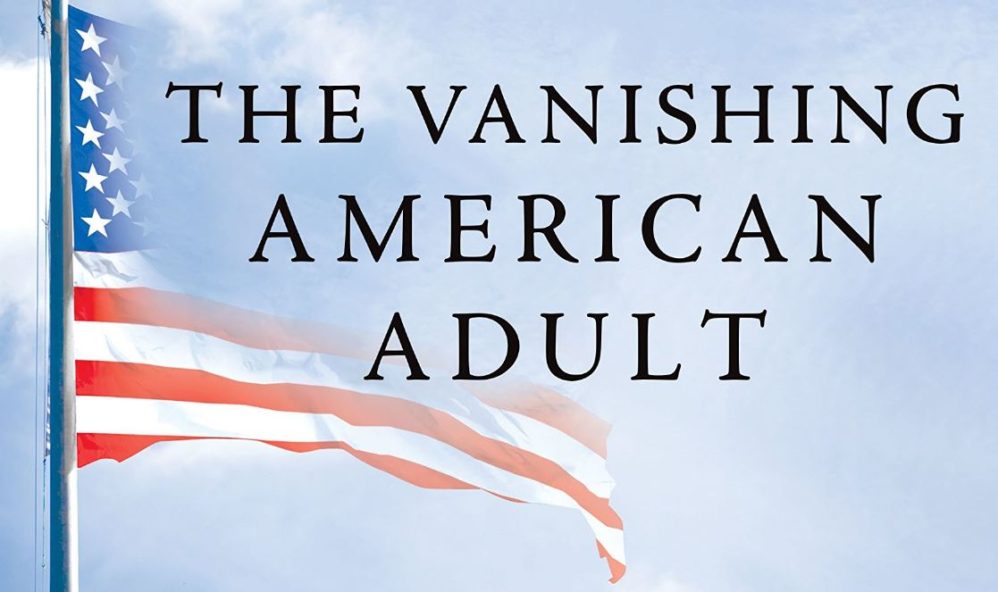
Senator Ben Sasse has written a new book called The Vanishing American Adult. I highly recommend it, especially for those of us concerned about the future of religious life in America. The book is a diagnosis and prognosis of the current situation of the youth in America. He doesn’t lay blame on American kids but mainly their parents for protecting them from challenges that will help them become adults. Adulthood is not just a biological stage but something to be earned. In the past, it was what we all needed to learn, whether or not we liked it. This is not the case anymore. Our culture endorses prolonged adolescence, upholding baby 40-year-olds.
Adults are responsible and virtuous as good citizens and members of the Church. They make tough decisions and take responsibility for their decisions. They are not passive but active. Senator Sasse’s book is important for those of us concerned with Religious Life because becoming a religious takes the virtues of an adult, putting away childish things. With the vanishing of the American adult, the Republic will not only suffer but also the Church, especially religious life.
Pray for parents. It is difficult to raise children in today’s culture of the vanishing adult. Unlike any time in history, the culture is raising kids more than the parents, undermining parental authority. Parents should be supported and encouraged to actively raise their children into the virtues. Senator Sasse gives some helpful advice on what he and his wife are doing for their children. Read his book and take his advice.
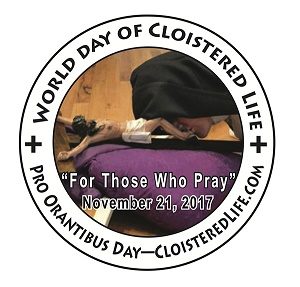
On November 21 (the Presentation of the Blessed Virgin Mary in the Temple), the Church will celebrate World Day of Cloistered Life, also known as “Pro Orantibus” Day, which is a Latin phrase meaning “for those who pray.” This is an important ecclesial event for all Catholics worldwide to commemorate the hidden lives of consecrated religious in cloisters and monasteries.
We celebrate this day because the contemplative life is a gift from Almighty God to us all — all the world benefits spiritually from the prayer and sacrifice of these dedicated and faithful souls, even when we may not know it. On this day, the faithful are encouraged to reach out to the cloistered and contemplative communities in their diocese, through prayer, encouragement, and material support.