Category Archives: Women’s Communities

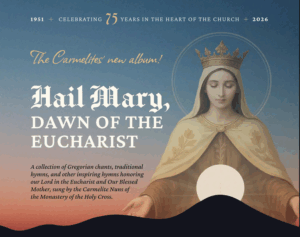
Iron Mountain Carmelites Celebrate 75th Anniversary

The Carmelite Monastery of the Holy Cross
Celebrates 75 Years in the Heart of the Church

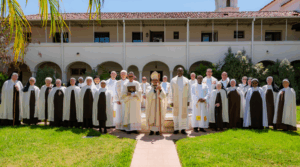
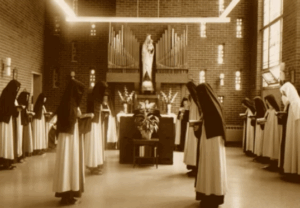
The “Holy Cross” has always been more than a mere title for the Monastery of Discalced Carmelite Nuns in Iron Mountain, Michigan. Together with the accompanying presence of Mary, it has in many ways shaped the life and history of the monastery’s seventy-five years of existence in the Diocese of Marquette.

The roots of this Carmel can be traced back to the twelfth foundation made by Holy Mother St. Teresa of Jesus in Caravaca, Spain, leading up to the Queretaro Carmel in Mexico. It was this community which in 1916, due to the persecution of the Church there, eventually found a warm welcome in Grand Rapids, Michigan. Vocations flourished and soon they began making several foundations of which the monastery in Iron Mountain was the seventh.

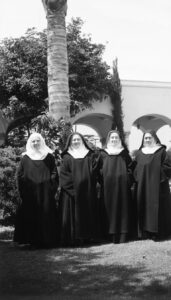
After a difficult eighteen-month search for a suitable site for the proposed foundation, Most Rev. Thomas L. Noa was able to report his success to the Carmel of Grand Rapids on November 1, 1950. It was the very day on which the dogma of the Assumption was formally defined in Rome. Shortly after this, on November 21, the Feast of the Presentation of Mary, the first group of nuns went to Iron Mountain to oversee the renovations which would be necessary to transform the small Horton Hotel on East B Street into a cloistered monastery.

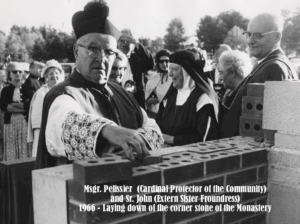
Under the paternal eye of Msgr. A.C. Pelissier, the beloved “Cardinal Protector” of the community, the remodeling was completed in four months. This made it possible for the monastery to be canonically erected on Easter Sunday, March 25, 1951, with the Solemn Mass of Dedication and establishment of Enclosure on April 11, Solemnity of St. Joseph.

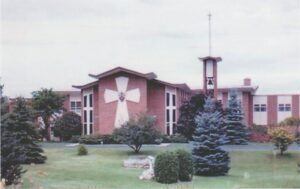
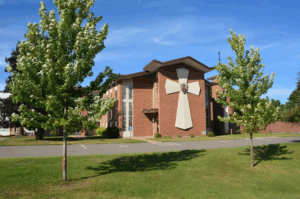
Despite additions made to the house on “B” Street, the blessing of many vocations made it necessary to plan for the building of a new Monastery. With the help of Saint Joseph, Carmel’s special protector and provider, and the generous support of so many good people, the new monastery, built in the form of a Cross, became a reality. The dedication was held on July 16, 1966, Solemnity of Our Lady of Mt. Carmel.

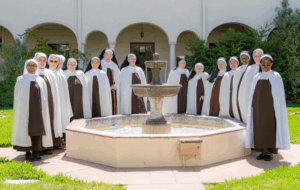
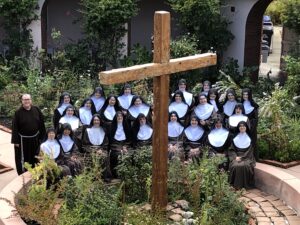
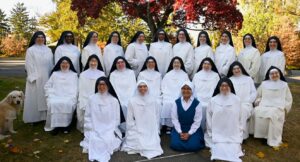
This year, March 25, 2026, the Monastery of the Holy Cross reached the milestone of its 75th Jubilee. Today seventeen nuns, including four Sisters in formation, gratefully and joyfully continue their daily efforts to live the charism of Carmel handed on to them. Praised be Jesus Christ!
A Life of Love, Prayer and Sacrifice

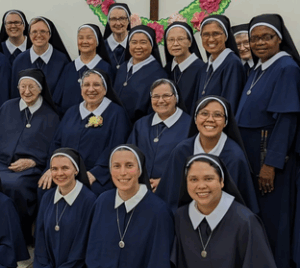
The Carmel of the Holy Cross is located in the vast wooded territory known as Michigan’s Upper Peninsula. Here lives a community of seventeen Discalced Carmelite nuns ranging in age from 27 to 101. Our Lord called these women together from many different backgrounds and from varied States as California, New Jersey, Texas and as near as Michigan and Wisconsin.
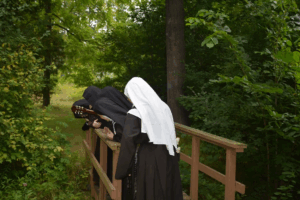
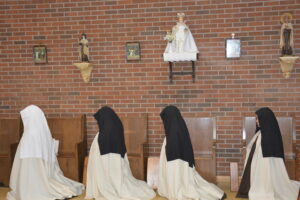
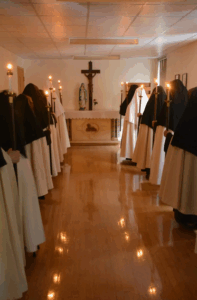
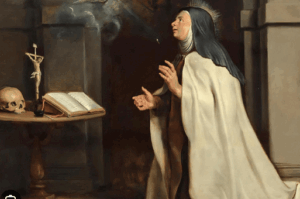
The Carmelite life is a balance between the eremitical spirit and a life in community. Silence and solitude are sought as pre-eminent means for fostering a life of prayer. Observing papal enclosure and wearing the traditional habit of the Order, they follow the life given them by their Holy Mother Saint Teresa of Jesus. Their goal is union with God – “to love Jesus and to win souls for Him so that He may be loved,” as St. Therese of Lisieux put it. The Carmelites use the same means Jesus Himself used in His hidden life at Nazareth and in His death on the Cross: prayer and sacrifice. They strive to give their all for the Church, particularly for priests and seminarians.

The monastery bell summons the nuns to various community exercises: daily Mass, the Hours of Divine Office, and mental prayer, the characteristic “work” of this Order of prayer. Devotion to Our Lady permeates the life of Carmel, for “Carmel is All Mary’s.” This devotion is expressed by some cherished traditions such as the daily Rosary and Litany of Our Lady, the Salve Regina solemnly chanted every Saturday evening, and the appointment of one sister each week to be “chaplainess of the Blessed Virgin Mary” —honoring Our Lady as each one feels inspired.

Even during work the Carmelites strive to observe silence. Besides ordinary tasks such as cooking, sewing habits, laundry and cleaning, the nuns bake and cut altar breads. The sisters also make articles to be sold in their gift shop at the entrance to the monastery. These include rosaries, scapulars, crocheted items, note cards and others. Within the spacious grounds of the enclosure are two large vegetable gardens cultivated by the sisters.
Saint Teresa incorporated two hours of recreation into the Carmelite’s day to provide healthful relaxation at which time the silence is dispensed. Ordinarily, the sisters bring handwork, but on occasion they go out to the garden or do some other outdoor activity. Sometimes they simply walk together on the grounds visiting one of the shrines, including their own cemetery surrounded by beautiful woods and fields. Tradition calls for a “play” on certain occasions which often includes a good bit of comedy. Thus, the Carmelite nuns live a life of love, prayer and sacrifice in simplicity and joy and, as Saint Teresa wrote centuries ago, “each one feels herself unworthy to have deserved to come to such a place…the Lord has so multiplied their satisfaction that they clearly understand the Lord has given them a hundredfold for the one they left; and they are never tired of thanking His Majesty.”
https://holycrosscarmel.com
vocation@holycrosscarmel.com

Consecration and Dedication of Cistercian Nuns Oratory

“Now I have chosen and consecrated this house that My name may be there forever; My eyes and My Heart also shall be there always.”   Chronicles 7:16

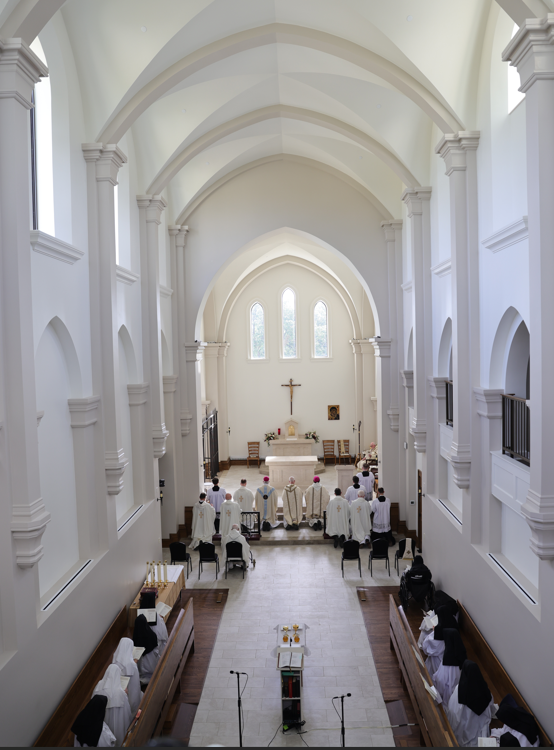
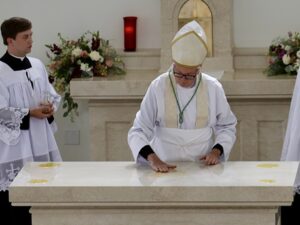
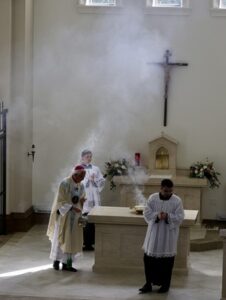
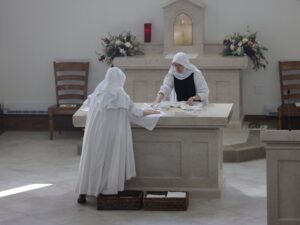
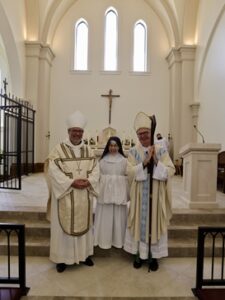
In March of 2024, the Cistercian nuns of Valley of Our Lady Monastery, twenty-one in all, moved into a newly-built monastery in Hollandale, Wisconsin, about one hour south of their old location.  The new monastery is situated in a place of greater solitude and space, enabling the sisters to better live out their particular charism in the Church—that of cloistered monastic life according to the Rule of St Benedict.  The final phase of building was completed some months after moving in, and August 24th, 2025, witnessed the final crowning of the project: the consecration and dedication of the monastery’s Oratory.  The rite was performed by Bishop Donald Hying, with several others concelebrating.  The guest nave of the oratory was full to overflowing with friends new and old of the community.

The Rite of Dedication of a Church is one of the Church’s most solemn liturgical acts and follows an ancient custom. It is the means of consecrating a church exclusively to God, making it a fitting place of prayer, praise, the celebration of the sacraments, and the reservation of the Eucharist. The church building is a visible sign of the Church, that is, the People of God who are the Temple of God made of living stones, a spiritual house built upon Christ, the cornerstone (see 1 Peter 2:4-6). Central to this rite is the consecration of the altar, which stands as a sign of Christ, who is the priest, the victim, and the altar of His own sacrifice.

A dedication is particularly significant for a monastic community, as the Oratory forms the heart of the monastery where they gather seven times a day to pray the Divine Office, daily to celebrate the Sacrifice of the Mass, and throughout the day to seek Our Lord’s Eucharistic Presence. The rite also recalls each nun’s consecration to God when she became a bride of Christ, enfleshing the bridal identity of the entire Church, a living temple of God’s presence in the world.  It also a place of vigil, waiting for the complete fulfillment of all our hope, trusting that He who began the work of building this place will fulfill it further in the New Jerusalem.

This is the culmination of years of listening to the Holy Spirit’s inspiration and trusting Him to bring His work to completion. Our Lord has multiplied His mercies allowing so many to participate in His plan to be praised, adored, and glorified in this place. Please join your prayers to theirs as they give praise and thanks to God.

valleyofourlady.org

For information about their building project: build.valleyofourlady.org/contact

Valley of Our Lady Monastery
7320 Urness Road
Hollandale, WI 53544

Triennial Federal Assembly of the Poor Clare Federation of Mary Immaculate

Los Altos Cloister Garden

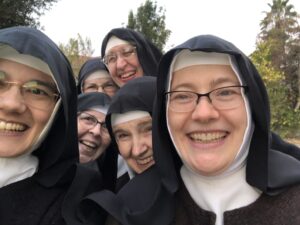
The triennial federal assembly of the Poor Clare Federation of Mary Immaculate in the United States of America was held October 8 – 15, 2025, at the beautiful Monastery of the Poor Clares in Los Altos Hills, California. Each of the twelve member monasteries (Alexandria, VA: Barhamsville, VA; Belleville, IL; Chicago, IL; Cleveland, OH; Kokomo, IN; Los Altos Hills, CA; Rockford, IL; Roswell, NM; St. Louis, MO; Santa Barbara, CA; Sauk Rapids, MN) was represented by its abbess and a delegate elected by that community’s solemnly professed nuns.It was like a foretaste of heaven to greet sisters from all over the country and to experience a joyous unity of spirit throughout the assembly.

Sr. Immaculata (Roswell) & Mother Dolores (Cleveland)

Mother Mary Angela, P.C.C., of Roswell, federal president since 2023, presided over the chapter, and was re-elected to serve a second term. Assisting her will be: Mother Mary Giovanna (Belleville, IL) as first federal councilor; Sister Miriam (Kokomo, IN) as second federal councilor; and Mother Marie Colette (Los Altos Hills, CA), as third federal councilor. This was the first assembly in which three councilors were elected, a change made to accord with the directives in Cor Orans.

The sessions of this assembly focused mainly on the revision of our federation’s Constitutions, and this blessed work will continue as the new triennium unfolds. The presence of Father Larry Webber, O.F.M. Cap., our religious assistant, enriched our discussions greatly, as he added his own perspective and vast experience to each session’s subject of focus.

One very special joy of the federation assembly is the sharing which occurs one-on-one among the capitulars before, after and in between sessions, and in every other possible free moment that can be found! These sharings, often taking place outdoor in the beauty of the monastery garden, deepen our sisterly unity in our shared ideal, and enrich us with a greater knowledge of each federated community.

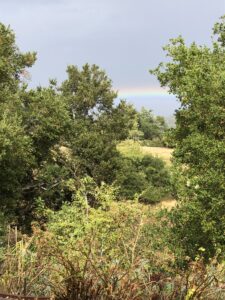
Rainbow

During an afternoon session on the day of the federation elections, one of the delegates politely interrupted the discussion in process to exclaim with true Franciscan joy and simplicity, “Pardon me, but if you look out that window, you’ll see that there’s a rainbow!” And again, in true Franciscan style, the capitulars immediately jumped up to see the glorious reminder of God’s undying love and everlasting covenant, wrought in the sky by the Divine Artist himself. It was an unforgettably beautiful sign of hope in this assembly specifically themed after the Jubilee Year of Hope.

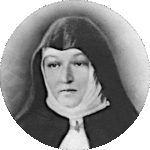
Another hallmark of this assembly was the 150th anniversary on Sunday, October 12, of Mother Mary Maddalena Bentivoglio’s arrival in the United States. Our sisters from Sauk Rapids and Saint Louis brought relics and memorabilia from Mother Maddalena, presenting an outline of the history of our Order from its beginnings in Assisi to the present day. Among the relics on display was Mother Maddalena’s own tunic, carefully kept these many years by our Sauk Rapids community. The St. Louis delegation regaled us during one of our recreation hours with the story of how, on their train trip from Missouri to California, they had carried the large bulletin board bearing photographs which told the pictorial story of the history of our Order – along with their regular luggage, and a big box of homemade bread for the capitulars! All agreed it was a story worthy of the Fioretti and should be written up in full for posterity, and they themselves felt they had been granted a share in Mother Maddalena’s own difficulties encountered along her pilgrim way as she ventured across the ocean to bring Poor Clare life to the United States.

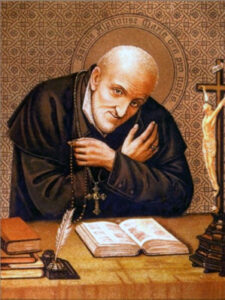
St. Alphonsus Ligouri

In her closing address on the final day of the assembly, Mother Angela quoted a circular letter written by St. Alphonsus Liguori to his novices: “It is only by lifelong sacrifice on the part of all concerned that a religious order can be founded, and it is only by the self-same sacrifice that its fervor can be maintained. The members of a religious family at any given moment have in their hands the making or the marring of their institute. The fact that it has a great name, was founded by a saint, or produced saints in the past, will not save it or them if their lives are tepid. If every novice, even, would remember that the honor of his order is committed to his charge, individuals and institutes would not fall into relaxation as they do.”

She exhorted the capitulars to go forth from this Assembly in an attitude of gratitude and wonder, which are prerequisites for a life of contemplation. Echoing Our Lady of Guadalupe’s words to St. Juan Diego, she encouraged each one to “Go now, and do your part.” As we go forward in our joyful observance of the Gospel as pilgrims of hope, each Poor Clare in our Federation of Mary Immaculate desires to hold high the light of hope for our world, so in need of the radiant light which Francis and Clare have bequeathed to their spiritual daughters.

For more information: cloisteredcontemplativepoorclares.org

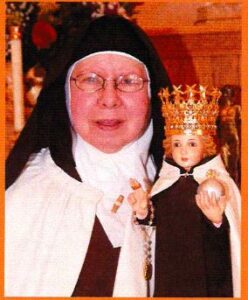
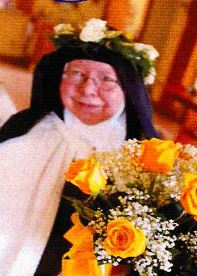
Mother Foundress of the Alexandria Carmel Passes Away

On October 9, 2025, Mother Marie Therese of the Child Jesus, OCD, died at her monastery in Alexandria, South Dakota.  Born Theodora Elizabeth Cycyk in Tonawanda, NY, in 1946, to Ukranian immigrants, she was fascinated by nuns but never saw herself as one of them.  That is, until the day when she randomly opened The Guide to Catholic Sisterhoods in the United States, and happened upon the Discalced Carmelite communities, featuring a picture of St. Therese of the Child Jesus and the Holy Face. So taken was she by this picture that she was happy to discover that there was a Carmelite monastery in nearby Buffalo! She entered Carmel on November 9, 1965.  This year she just missed celebrating her 60th Jubilee.

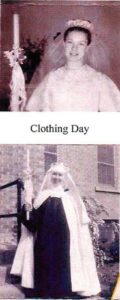
Mother Veronica had a name picked out for her on her clothing day but when she saw Theodora dressed up in her wedding dress, her hair in a bun atop her head looking like St. Therese, she changed her mind and gave her the name, Sr. Marie Therese of the Child Jesus.

Mother Marie Therese became Novice Mistress and then Prioress.  In 1996, she agreed to a request by Bishop Robert Carlson to make a new foundation in the Diocese of Sioux Falls, South Dakota.  They revamped a property offered by Fr. Robert Fox (the Fatima Priest) located across from the Fatima Family Shrine, the first monastery of contemplative nuns in South Dakota. “Here I will leave her bones!” she said.

On the day of her death, the sisters were alerted to her condition and finished their daily rosary at her bedside.  A priest administered the Apostolic Pardon just before she died. Her funeral took place on October 13th, the anniversary of the Miracle of the Sun at Fatima.

From her sisters:  Please join us now as we earnestly pray that if Mother Marie Therese is not there already, Our Lord will soon welcome her into His loving embrace in an “Eternal Face to Face” (St. Therese). Know that we (and she) are most grateful for your prayers, and that Mother will be most anxious to recommend you, your loved ones, and your concerns to Jesus.

Monastery of Our Mother of Mercy & St. Joseph
PO Box 67
Alexandria, SD 57311

You can go to their website to support their building campaign to build a new chapel dedicated to the Holy Face of Jesus!

HolyFaceChapel.org

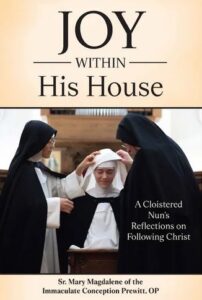
Joy Within His House: A Cloistered Nun’s Reflections on Following Christ

Sr. Mary Magdalene of the Immaculate Conception, OP, a member of the  Dominican Monastery of Our Lady of the Rosary in Summit, New Jersey,  has written a book to give those who live on the outside of the cloister a glimpse into the experience of those who live within. Called Joy Within His House: A Cloistered Nun’s Reflections on Following Christ, in it she shares the joy she finds in living the life of a cloistered nun and following Christ. Several dozen captivating photographs from inside the cloister help to illustrate the prayer, study, work, and recreation that order the nuns’ days.

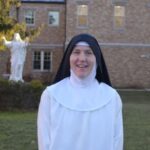
Sr. Mary Magdalene of the Immaculate Conception, OP

Many people may have misconceptions about monastic life, especially the cloister: what nuns do all day, what they are like, why they choose this life, and what they have given up. A life of contemplation is not something esoteric, secretive, or hidden; rather, it is a mystery.

Despite facing some different day-to-day realities, you might just find one or more facets of that mystery that will enrich your own life. This book demonstrates that laypeople can also take the principles of Dominican spirituality and monastic life and use them as tools to help them grow in holiness. to encourage others to become saints, and to try to give lay people the principles of monastic life that they can use to help them live as better Christians.  At the same time, religious can glean many helpful points from it as well.

At the Dominican Monastery in Summit, the Holy Sacrifice of the Mass is the heart of their monastic life, where they unite their lives with Christ which is then offered to the Father in a holocaust of praise for the salvation of the world. The Divine Office flows out from the Holy Sacrifice of the Mass, extending their worship of God throughout the day. Flowing from their life of liturgical praise is private prayer and lectio divina. They also have the special privilege of both perpetual adoration of the Blessed Sacrament joined with the prayer of the rosary. This they call the Adoring Rosary.

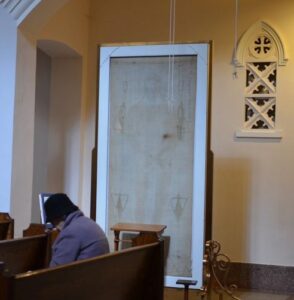
For those who would like to visit their monastery chapel, here is something amazing they can see — a 400 years old copy of the Shroud of Turin!  This Shroud replica was commissioned by the Most Serene Infanta, Maria Maddalena of Austria, Grand Duchess of Tuscany, wife of Cosimo de’ Medici in April, 1624. To give the copy greater value it was placed for a time on the Shroud of Turin. In gratitude for the generous help of the fledgling Monastery in Summit, New Jersey after World War I, the Dominican Nuns of St. Catherine’s Monastery gave it to the Summit Dominican Nuns on April 6, 1924.

To order:  please visit the Dominican nuns’ Cloister Shoppe or Amazon or the OSV Catholic Bookstore.  The Cloister Shoppe also has their famous Seignadou Soap products and other handcrafted goods like greeting cards, candles, and handmade wood rosaries.

The book will be released on October 13, 2025, but you can pre-order to reserve a copy!

To learn more about the community: summitdominicans.org

Little Missionaries of the Sacred Heart – New IRL Affiliate Community

Welcome to a new  IRL Affiliate Community!

The congregation of the Little Missionaries of the Sacred Heart, based in Livorno, Italy, opened a new foundation in the diocese of Des Moines, Iowa, in 2012. Following the desire of their Foundress, Mother Clotilde Gigli (1872-1928), “to work with humility, so that the mercy of the Heart of Jesus may be known,” they are involved in the fields of education, health care, parish work and missionary evangelization.

There are currently four sisters serving in the community in Iowa who work at the Bishop Drumm Retirement Center as registered nurses and certified nurse assistants. “Their presence is cherished in our Diocese,” says Most Rev. William M. Joensen, Bishop of Des Moines, “and they are well respected as holy and dedicated women giving strong witness to Christ in the grace-filled living out of the evangelical counsels.” (LMSHsisters.com)

Passionist Nuns of Pittsburgh Approved as New IRL Affiliate

The Passionist Monastery of Our Lady of Sorrows in Pittsburgh, Pennsylvania, was founded in 1910 by five Passionists nuns from Tarquinia, Italy, the first community of Passionist Nuns in the United States. They are a contemplative cloistered community of religious women called to stand at the foot of the Cross with Mary near the Heart of Christ, ready to receive His love so that they might become love in the Heart of the Church.

St. Paul of the Cross founded the Congregation of the Passion (Passionists) in 1720, desiring to gather around him companions who saw the Passion of Jesus as God’s love-message to them and the world. In 1771, the first monastery of the Passionist Nuns was opened in Tarquinia, Italy.

The nuns bake altar breads to support themselves, supplying them to churches and religious communities. They are grateful for this labor of love which is transformed into the Body of Christ.

As Passionists, we are called to keep alive the Memory of Christ’s Passion. We do not only recall it in our minds, but we render it present in our lives by living His self-emptying love in our daily lives for the salvation of souls. Passionists live intensely the Mystery of Redemption for the benefit of the whole Church and for all people.

Our primary apostolate is prayer. We witness to the primacy of God and to the priority of adoration of God. We remain faithful to St. Paul of the Cross’ original inspiration to have the nuns share their contemplative way of life with others. Our House of Prayer provides a place of solitude for those who wish to enter into prayer.

PassionistNunspgh.org

New Video Reveals Mystery of the Seven Spanish Martyrs of the Visitation

By Visitation Sisters of the Second Federation (and Kevin Banet)


One hundred years ago, anti-Catholic sentiment in Spain was high, and nearly 8,000 martyrs suffered for their faith. Among them were seven nuns of the Visitation Order from Madrid, now known as Blessed Maria Gabriela and her Companions.

A new video tells their story and reveals the mystery of the seventh martyr, who was the youngest and who died last. The Seventh Crown — Martyrs of the Visitation is only 35 minutes long but delivers a compelling portrait of the struggles of the nuns while their monastery was under the surveillance of the authorities.

Cross carried by Sr. Maria Cecilia

In 1931, Spain witnessed a political upheaval, and the uneasy climate led the superior of the Visitation in Madrid to order the 83 nuns there to wear lay clothes and leave the monastery. They eventually returned, only to leave again. Seven were chosen to remain, but eventually moved to an apartment. On November 18, 1936, the sisters were apprehended, put into a truck and driven a short distance. When they got out of the truck, six of them were shot dead, and the seventh — Sr. Maria Cecilia, age 26 — escaped by running away.

The movie is told in a flashback mode through the eyes of this sister, whose whereabouts after her escape remained a mystery for five years. Her tense story is revealed in the last scene with her martyrdom.

The sisters had many opportunities to flee, so the question might be asked, “Why did they not try to escape martyrdom?” The primary reason, as stated in the movie was, “We are awaiting the palm of martyrdom and if by shedding our blood Spain can be saved, Lord, may it be as soon as possible.”

The martyrs were beatified on May 10, 1998 by Pope St. John Paul II and await canonization.

The Order of the Visitation was founded by St. Francis de Sales and St. Jane de Chantal in 1610 in Annecy, France. The aim of the Visitation is: “to give to God daughters of prayer, and souls so interior that they may be found worthy to serve His infinite Majesty and to adore Him in spirit and in truth.”

The acting in the movie is realistic and rich in imagery of the Visitation nuns and their monastic surroundings. It was produced by Home of the Mother, an international public association of the faithful with pontifical approval. It has been viewed on YouTube 54,200 times since its premiere on November 22nd. The movie, La Séptima Corona — Mártires de la Visitación is in Spanish, but English subtitles can be turned on.

SOURCES:

https://vistyr.org/blessed-sister-martyrs

Home of the Mother

Servants of the Children of the Light: Dedicated to Catholic Montessori Education

Mother Chiara Thérèse, Sr. Lucia Rose and Bishop David Kagan. Photo by Deborah Kates Fine Photography.

On October 1, 2020, the feast of St. Thérèse of the Child Jesus, Most Rev. David Kagan of the Diocese of Bismarck established the Servants of the Children of Light, a Public Association of the Christian Faithful for Women.  The community has the apostolate of Catholic Montessori education rooted in a life of contemplative prayer. The Servants currently serve at Christ the King Catholic Montessori School in Mandan, North Dakota, just west of Bismarck.

Many people do not associate Montessori Education with the Catholic Church, but it was Dr. Maria Montessori’s dream to have a religious order promoting her vision of childhood education. “An individual working alone can be compared to a man digging by himself in a field whereas the work of a religious Order, by comparison, is like that accomplished by a bulldozer,” she said. Dr. Montessori was a Catholic medical doctor who devoted her life to a child-centered approach to learning.  Her first childcare center in poor, inner-city Rome was called Casa dei Bambini, the “children’s house.”

Foundress Mother Chiara Thérèse received her childhood training in Catechesis of the Good Shepherd, a catechetical program for children ages 3-12 rooted in Sacred Scripture, the Liturgy, and the educational philosophy of Maria Montessori.  Mother also obtained an AMI Montessori Assistants to Infancy diploma (birth to 3) from the Southwest Institute of Montessori Studies in Mesa, AZ, a bachelor’s degree from North Dakota State University, a diploma in Spiritual Theology from the Teresianum in Rome and a Master’s in Theology and Christian Ministry from Franciscan University of Steubenville, OH.  Her religious name is tied to their charism.  “I chose Chiara because it means ‘light’ in Italian and Thérèse for her childlike abandonment, a desire to live a childlike obedience.”

The new community, in addition to the vows of poverty, chastity and obedience, take a fourth vow—to serve Christ in the child.  The sisters who enter the community will “pursue an AMI Montessori diploma, according to the age of the children they feel called to serve,” said Mother Chiara Thérèse.

“We know that Dr. Montessori was a devout Catholic,” said Mother. “In fact, she said, as E.M. Standing recounts, that ‘her own method could only find its fullest expression when applied to the teaching of the Catholic faith.’”   She also noted that “Dr. Montessori also believed that ‘the true respect of the child is only possible when one respects God in the child.’”

The daily conventual Mass of the community is celebrated, where possible, in the Extraordinary Form of the Roman Rite. The sisters pray in community the Extraordinary Form of the Divine Office. They wear a modified Benedictine habit and a medal of the “Madonna of the Chair” (Madonna della Seggiola) by Italian artist, Raphael, that depicts Our Lady holding the Child Jesus.

“Bringing back a deep and Faithful Montessori-Catholic education is indeed something we desire to spread,” wrote Mother Chiara Thérèse. “Dr. Montessori’s method is so deeply rooted in the Catholic faith that we have seen a beauty in the children when the method is given its fullness.”

Servants of the Children of Light 
Christ the King Catholic Montessori School
505 10th Ave. NW
Mandan, ND 58554
vocations@servantsofthechildrenoflight.org
servantsofthechildrenoflight.org

You can also read more on the Diocesan website.

Buffalo Carmelites Relocate to Diocese of St. Augustine

After a century in Buffalo, New York, the Discalced Carmelite Nuns have relocated to the Diocese of St. Augustine.  As the sisters noted in their farewell letter to their friends, their monastery used to be on the outskirts of Buffalo where they could live their contemplative life in silence and solitude.  This is no longer the case.

Here are some words from their newsletter describing their arrival in Florida:

Thanks to the hard work of many kind and generous friends who prepared for our arrival, our new monastery felt like home from the very first moment, already embellished with many of our beautiful statues and holy images. But it truly became “home” when Jesus Himself came to dwell among us in His Eucharistic Presence after the first Mass in our lovely little chapel. We were moved to tears and well understood the sentiments of Our Holy Mother St. Teresa, who considered that a new foundation was truly established when the Blessed Sacrament was permanently reserved in the tabernacle. The difference was palpable – our beloved King is now enthroned and dwells among us!

Before we were enclosed, on our first full day in Florida we had the incredible blessing to visit the Shrine of Our Lady of La Leche, where our new Bishop, the Most Reverend Erik T. Pohlmeier, welcomed us warmly and offered Holy Mass for us. While there, we were able to tour the “Sacred Acre” where the first parish Mass was offered in what is now the United States on September 8, 1565. Our Lady’s maternal presence is so strongly felt on that site which has such historic significance for the Church in our country!

You can read more about their move here: https://www.carmeljax.org/news

Their monastery in Buffalo was founded by Mother Mary Elias of the Blessed Sacrament, OCD (1879-1943), who as she knelt before a Mexican firing squad (her crime was persevering in her Carmelite vocation), made a promise to St. Therese of Lisieux to found a monastery in her honor if she was spared.  The guns were fired, Mother and her companion fell to the ground, and when they regained consciousness, there was blood on their clothes but they were unharmed.  Mother kept her promise and the monastery of the Little Flower of Jesus was founded in Buffalo.

In their current temporary location they do not have a public chapel or gift shop for visitors.  They are praying to locate a suitable property and the funds which will allow them to build a permanent monastery which can house their growing community.

Vocation inquiries may be directed to:
 PO Box 1012
Ponte Vedra Beach, FL 32004, USA
(904) 648-2663

Their physical address is:
8002 James Island Trail, Jacksonville, FL 32256