Category Archives: Reflection

Five Ways to a Closer Relationship with Christ by Br. Daniel Sokol, OSB

Five Ways to a Closer Relationship with Christ  &
Five Steps to Living Our Faith in Christ
  1. Social

Exemplary, Holy People:  We want to imitate the behavior of people who are doing or have done well, e.g., Apostles, Saints, Good Parents, Mystics, recent Popes, Spiritual Writers, Good Relatives that made a positive impression on us, etc.  We want to imitate them so we can become good like them!  Note that we are not highlighting self-help programs or gurus that do not include God, but real, known, certified and proven life-long Holy People who have earned their measure of Goodness and Respect.  They have earned their status as Noteworthy Persons to imitate, each with his or her own unique set of Virtues.

Ourselves:  We must recognize and acknowledge our God-given Goodness and Dignity, our call to Holiness.  By “owning” the Positive Aspects and Truths of our Faith and the Rewards that follow, we Cooperate towards building up the Kingdom of Heaven, the Mystical Body of Christ.

  1. Rewards

Benefits of Following Christ.  Authentic following of the self-emptying Example of Christ and known Saints makes us feel better about being a Good Citizen, a Good Catholic, a good all-around, Well Adjusted, Highly Motivated, Positive Human Being.  Worthy People are the ones we like to associate with and imitate, thus we know that we are doing right for God. They truly Live the calling to Imitate Christ; they Affirm and Inspire us by their Holy Example.  Living the Christian Virtues brings about its own rewards, such as Freedom, Peace, Harmony and Happiness.

Rewards of Heaven.  The knowledge of Being Happy in Heaven forever and ever and ever makes us want to go there—more and more and more!  Eternal Happiness in God is well worth any price you can name, especially in light of its permanent, eternal nature.  As we become more Christ-Like, we enjoy a Greater Share in His Divinity; We become more “Divinized”.

  1. Marks of Progress

We can log our daily Progress in Honest Journaling, marking of Calendars, charting our Progress.  Remember the Good we have Accomplished by Participation in the Graces that Christ earned for us, and still offers twenty-four hours each and every day and night.   Journals or notes help review the trials we encountered and Progress Achieved.  They recognize and Appreciate the many graces God has Gratuitously Bestowed upon us for our good and our work to Share these gifts with others.  It is good to Savor these Precious Moments and to Offer Thanks.  This is expressing pure Honesty, not false pride.  And remember that Heaven will be filled with Grateful People.

  1. Keep Good, Healthy Control of our Own Environment(s)

We want to maintain Healthy Control of our own environment for the Good of our souls.  Think about how we Want to Change for the better, and devise a Plan.  We can Simplify our home, our heart and our environment.  We work to Maintain clean, Healthy Living conditions both physically, mentally and especially spiritually.  We put good, Achievable Limits on the use of the TV, Internet and cell phones.  Turn them off and Enjoy the Silence.  Bring in Prayer, Contemplation, Reading of Sacred Scripture and Spiritual Writings such as the Fathers of the Church, Lives of the Saints, Documents of the Church, Catechism of the Catholic Church, etc.  Abbot Claude used to say, “Don’t read good books, read only the best.”  We can Capitalize on how to Improve our internal and external environment without becoming a fussy perfectionist.  Enjoy your own yard, take a walk around the block, visit a park for a time of Rest and Refreshment.  Bring your lunch and Enjoy the day as yet Another Gift God has given to us.

  1. Spiritual, Physical, and Healthy Asceticism
    (Self-denial for the sake of the Kingdom)

We can focus on how to make Holy Progress in the proven, ancient and Holy Art of Asceticism.  How?  First of all, we must recognize that no true Spiritual Progress can be made without our own Cooperation, our own Sacrifices, and our own authentic Participation in the life and example of our Savior.  Being of Service to our neighbor is one of the marks of Healthy Asceticism.  Being Fair and Civil to people we don’t like generates Peace and Trustworthiness.

True Sacrifice will often cost us some time, some inconvenience, some effort.  Jesus Christ was constantly dying to Himself in order to Accommodate the teeming masses of people ranging from the merely curiosity seekers, those outraged at His behaviors, the hungry, the weak, the envious, the rule-bound religious authorities, the faint-hearted, those who had nothing else to lose, and the Holy Remnant who had enough faith to follow and Believe in Him who is and was.  Christ endured with Holy Love for our Eternal Salvation inconvenience, suffering, being degraded and death.

So, how are we to map out ways to more Fervently Accomplish the will of Christ in our own daily lives?  What are some Positive Steps we can make to Improve the lot of all mankind?

Five Steps to Living Our Faith in Christ

 Step #1: Ask God to Enhance our own Faith, regardless of how little or how much we already have.

Step #2: Learn how to die to ourselves often, so that we can Accommodate the manifold Graces Offered, and become more Available to our neighbors.  Thank Him for any Progress made.

Step #3: Seek out our own Peace in God by fostering this Peace and Harmony among all people we meet or associate with, often at the cost of our own inconvenience.

Step #4: Be more eager to practice Sufficiency and not excess, to Fast, to Prayerfully Read Scripture, to Contemplate God’s Love for us and His Love for our neighbors.

Step #5: Become more Approachable by being Patient, Kind and Accommodating.  Learn how to give Support and Encouragement to one another.  Always be Grateful for what you receive.

Perseverance in these proven methods will reap multiple Rewards, the most important of which is following after the will and Example of our Lord and Redeemer, Jesus Christ of Nazareth, while working towards Achieving the Kingdom of Heaven, both here and hereafter.  Christian Discipline brings on great and Lasting Benefits for ourselves and for the entire Body of Christ.  For some who are well-versed in the practice of all of the Virtues, their Hope is a Positive, ever-present reality and source of Divine Energy throughout their entire lives.
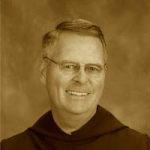
Brother Daniel Sokol, OSB, is a Benedictine monk at Prince of Peace Abbey in Oceanside, California.
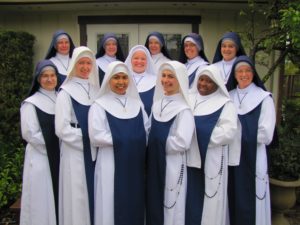
New IRL Affiliate Alert: Marian Sisters of Santa Rosa!

“What earlier generations held as sacred, remains sacred and great for us too… It behooves all of us to preserve the riches which have developed in the Church’s Faith and prayer, and to give them their proper place.”  ​
​- Pope Benedict XVI, concerning the venerable liturgical rites of the Church

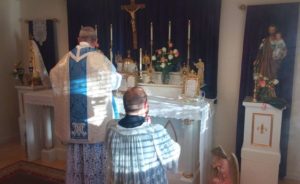
We at the IRL are happy to announce a new community added to our roster: Marian Sisters of Santa Rosa!

The Superiors of the Marian Sisters previously belonged to another religious Traditional order, however at the gracious invitation of Robert F. Vasa, Bishop of Santa Rosa, California, they founded a new community “to make visible the invisible reality of God’s love in the Diocese of Santa Rosa.”

As Marian Sisters, they live and love at the heart of the Church.  Their spirituality can be described as Ecclesial, Eucharistic, and Marian.  This is, in part, lived out through their charism of living the fullness of the liturgical life of the Roman Catholic Church – they participate in both the Ordinary Form (Novus Ordo) and also the Extraordinary Form (traditional Latin) in their chapel several times a week and provide the choir for the Extraordinary Form High Mass at the Cathedral each Sunday.

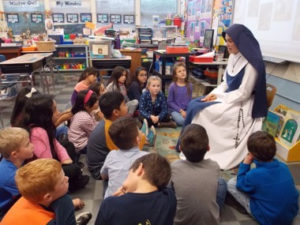
Since their founding, the community has grown and its active apostolates have expanded.  Committed to the spread of the faith in the Diocese, every Sister teaches the Faith in some manner.  While some are formal classroom teachers, most of the Sisters exercise the charism more broadly through children’s catechesis, faith formation groups, retreats and camps, and any other way in which God’s will is made manifest.

Called to a life of total consecration to Christ and His Church, the Sisters take the Blessed Virgin Mary as their inspiration and model and dedicate their time and talents completely to the service of God and neighbor.

The Constitutions of the Marian Sisters of Santa Rosa  were approved and canonically erected the community on January 4, 2012.


New Website Alert: Poor Clare Colettine Nuns of Corpus Christi Monastery in Rockford, IL

In the Fall of 2017, a seminarian for the Diocese of Rockford, Jack Reichardt began exchanging letters with Poor Clares Mother Abbess, Mother Maria Dominica, PCC, in order to obtain permission and discuss building a new website for the local monastery, home to twenty professed nuns.

Finally meeting at the Monastery in January, Reichardt and Mother Dominica decided that the site should serve two purposes:

  1. To appear to an audience of those women who may be discerning a call to the consecrated life as a Poor Clare nun, and
  2.  To appeal to the faithful who would like to visit with the Poor Clares in prayer.

Having taken a web design course while in high school, Reichardt wanted to put his hobby to use and build something worthy of the Poor Clares that reflected their “beautiful life, that is chaste and pure and prayerful” where people could find out more about their history, life, and vocation.

Click here: Poor Clare Colettine Nuns of Rockford, Illinois | JMJ+FCC

In gratitude for his hard work, one of the sisters offered the following remarks:

“[Jack’s] deliberation and prayerfulness impressed us very much, and his competence to create a site that is simple but beautiful and which effectively reflects our way of life has been crowned with success. We are grateful to him and to all those who contributed!”

New Affiliate: The Dominican Nuns of Our Lady of Mt. Thabor Monastery in Ortonville, Michigan

The IRL is very delighted to welcome a new affiliate: The Dominicans Nuns of Our Lady of Mount Thabor Monastery in Ortonville, Michigan (Archdiocese of Detroit).  The contemplative community lives the joy-filled monastic life of prayer, work, silence, and study… all for the sanctification of souls!
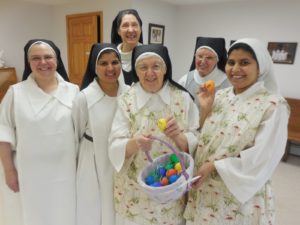
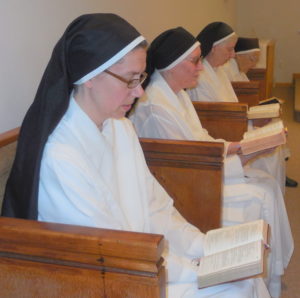
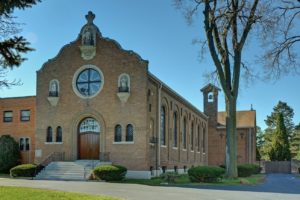
The foundation of the Monastery began in 1969 when two nuns, Sister Mary Martin, O.P. and Sister Anne Mary, O.P. received permission to leave the Dominican Sisters of the Perpetual Rosary Monastery (Blue Chapel) in Union City, NJ, to establish a new contemplative mode of life within the monastic setting.  Remaining faithful to the essentials of monasticism, they eventually found a home in Detroit at the invitation of John Francis Cardinal Dearden. In August of 1973, they moved into their current location in Ortonville, in rural Oakland County.  Their foundation day is August 6, 1973, the feast of the Transfiguration of Jesus Christ on Mt. Thabor. The community received its letter of aggregation into the Dominican Order in 1999.

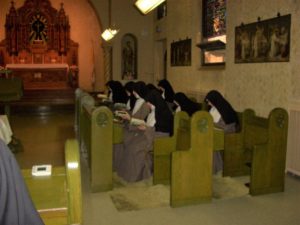
Their daily schedule focuses on the Divine Office (Liturgy of the Hours), which they sing or chant together in chapel. The Holy Sacrifice of the Mass is celebrated daily and is the center of their contemplative life.  Profound silence is observed from after Compline until after Morning Prayer. Their habit is a simple white tunic, black veil, leather belt with rosary attached, and scapular.

The community is self-supporting and does remunerative work for its self- sufficiency.  Sewing services are offered by the Sisters including the making and alteration of Dominican habits as well as the sale of Dominican Third Order Scapulars.  They also maintain Transfiguration Retreat House where faithful may come for a private retreat.  The intellectual life is nourished through reading, research, and study.  This strong charism of the Dominican Order is never neglected.

The Holy Father’s January 2018 Intentions

That Christians in Asian countries may be able to practice their faith in full freedom.

Please read the inspiring homily by Pope Francis at the 2015 Mass of Canonization of Saint Joseph Vaz († 1771).  He was an Oratorian missionary priest who was born in India and ministered in Sri Lanka, a country that, despite the best efforts of this holy man, was and remains today to be predominantly Buddhist.   His feast day is January 16.

https://w2.vatican.va/content/francesco/en/homilies/2015/documents/papa-francesco_20150114_srilanka-filippine-omelia-canonizzazione.html

The Vanishing American Adult and the Religious Life

Senator Ben Sasse has written a new book called The Vanishing American Adult. I highly recommend it, especially for those of us concerned about the future of religious life in America. The book is a diagnosis and prognosis of the current situation of the youth in America. He doesn’t lay blame on American kids but mainly their parents for protecting them from challenges that will help them become adults.  Adulthood is not just a biological stage but something to be earned. In the past, it  was what we all needed to learn, whether or not we liked it. This is not the case anymore. Our culture endorses prolonged adolescence, upholding baby 40-year-olds.

Adults are responsible and virtuous as good citizens and members of the Church.  They make tough decisions and take responsibility for their decisions. They are not passive but active. Senator Sasse’s book is important for those of us concerned with Religious Life because becoming a religious takes the virtues of an adult, putting away childish things. With the vanishing of the American adult, the Republic will not only suffer but also the Church, especially religious life.

Pray for parents. It is difficult to raise children in today’s culture of the vanishing adult. Unlike any time in history, the culture is raising kids more than the parents, undermining parental authority. Parents should be supported and encouraged to actively raise their children into the virtues. Senator Sasse gives some helpful advice on what he and his wife are doing for their children. Read his book and take his advice.

Buy the book here. 

Tuesday, November 21, 2017 – World Day of Cloistered Life

On November 21 (the Presentation of the Blessed Virgin Mary in the Temple), the Church will celebrate World Day of Cloistered Life, also known as “Pro Orantibus” Day, which is a Latin phrase meaning “for those who pray.” This is an important ecclesial event for all Catholics worldwide to commemorate the hidden lives of consecrated religious in cloisters and monasteries.

We celebrate this day because the contemplative life is a gift from Almighty God to us all — all the world benefits spiritually from the prayer and sacrifice of these dedicated and faithful souls, even when we may not know it. On this day, the faithful are encouraged to reach out to the cloistered and contemplative communities in their diocese, through prayer, encouragement, and material support.

Please click at the link for more info and for resources: //www.cloisteredlife.com/news/pro-orantibus-day/

Beauty and Religious Life

Most of us recognize the beauty of the religious life. For most, the beauty of monasticism stands out. But its other forms us as beautiful as well because love is the motivating center.  But why is the religious life beautiful? In order to answer that question we should first list the classical criteria of beauty. Thomas Aquinas says three things are necessary for beauty:

First, (1) integrity or perfection, for things that are lacking in something are for this reason ugly; also (2) due proportion or consonance; and again, (3) clarity, for we call things beautiful when they are brightly colored.

Since Christ is Love made visible and religious life is conformity to Christ, religious life is a continuation of that love made visible in Christ. Love is perfect, showing forth integrity (1). There is no lack. It is the perfection of all things. It is harmonious and proportionate (2). It does not undermine a(they part or add superfluity. The parts are united into a harmonious whole (order). Lastly, it shines forth (3). It communicates itself, bringing others into its life.

If religious life is an intense participation in the Christ life which is Love, it will meet these three criteria. In an age full of thrills but lacking in beauty, Dostoyevsky’s prophecy that “beauty will save the world” needs to be taken seriously. Taking into consideration what was said above, then it makes sense to say the beauty of the religious life is integral to saving the world because in and through it Christ is encountered.

Oh Priest, Who Are You?

On this Holy Thursday when we thank God for the institution of the Sacraments of the Holy Eucharist and the Holy Orders, it is good to recall this meditation on the priesthood by St. Norbert:

norbertO Priest, who are you?

You are not yourself, because you are God.
You are not of yourself because you are the servant and minister of Christ.

You are not your own because you are the spouse of the Church.
You are not yourself because you are the mediator between God and man.

You are not from yourself because you are nothing.
What then are you? Nothing and everything.

O Priest!

Take care lest what was said to Christ on the cross be said to you:
‘He saved others, himself he cannot save!’

Pope Francis Prayer Intentions – January

PopeFrancisPrayingThe Holy Father’s prayer intentions for the month of January and as well as reflections by Fr. James Kubicki, S.J., National Director of the Apostleship of Prayer.

1. Universal Intention

That all may promote authentic economic development that respects the dignity of all peoples.

Pope Francis sees that the “worship of the golden calf of old (see Exodus 32: 15-34) has found a new and heartless image in the cult of money” which puts making money ahead of people. “Concealed behind this attitude is a rejection of ethics, a rejection of God. Money has to serve, not to rule!”

The universal intention this month challenges us to examine ourselves and our choices, for as the Holy Father declared: “The Pope appeals for disinterested solidarity and for a return to person-centered ethics in the world of finance and economics.”

1 Timothy 6: 6-10 The love of money is the root of all evils.

2. Evangelization Intention

That Christians of diverse denominations may walk toward the unity desired by Christ.

Because there are obvious divisions among Christians, the world has trouble believing in Jesus. Thus, part of evangelization—spreading the Gospel—is work and prayer for unity. At the Last Supper Jesus prayed to the Father that Christians “may all be one…so that the world may know” that the Father sent Him (John 17: 20-23). This unity among Christians must be visible so that the world can see and believe.

During the annual Octave of Prayer for Christian Unity, January 18-25, we pray with Pope Francis that the Holy Spirit may make us one as Jesus and the Father are one—so that the world may believe.

James 4: 1-12 Where do the conflicts among you come from?

For Father Kubicki’s complete reflections, please visit the Apostleship of Prayer.